Following up on the conversations posted last Fall, we invited more colleagues to share their concerns and commitments with strategies for critical research and teaching, to theorize and act
from within and together in solidarity.
Zahra Ali, Sang Hea Kil, John Eperjesi
Following up on the conversations posted last Fall, we invited more colleagues to share their concerns and commitments with strategies for critical research and teaching, so that we may theorize and act from within and together in solidarity, as Zahra Ali powerfully argues in the first contribution below. She urges us to build “transnational spaces where we can collectively imagine the world we want to live in, not only the one that we are standing against.” Next, as the only tenured full professor to have been fired for anti-genocide and pro-Palestine speech in 2025 and then reinstated this past June, Sang Hea Kil demands that we organize against what she calls the “Matrix of Administration Domination” that attempts to silence faculty. She calls on us to build and strengthen our unions to “fight and organize to divest from death, destruction and unjust wars.” Last but not least, John Eperjesi shares his trajectory of how he found himself teaching in Korea and the connections he has come to make between the history of US complicity in genocide in places like Jeju with that in Gaza. His teaching links seemingly far-flung works by John Steinbeck, Kim Stanley Robinson, and Refaat Alareer to recall Edward Said’s point that “telling stories, the power to narrate, is an act of life.” Relatedly, Kozue Uehara and Wendy Matsumura discuss the documentary film, Earth’s Greatest Enemy, and the Okinawan struggle against US militarism in the context of the Palestinian struggle against the US-Israeli genocide. As we return to the classroom this Fall, we hope these contributions inspire and energize our struggles, both on and off campus.
*
On Solidarity: From Iraq to Palestine
Zahra Ali (Rutgers University)
It has been three years, and we are still running out of words. We use the term genocide almost obsessively, while knowing that what is happening in Gaza is beyond that. It is beyond words.
What are words after all? Just sounds, fragments of our feelings, of our limitations.
In the past three years, I have had many months of nihilism, of paralysis. I could not write, I could not think. I felt: everything has been said. Is there anything left to say?
Feelings are a form of knowledge. Knowing is a feeling.
This feeling, this reaction was not coming out of nowhere; it was the result of having spent my entire adult life organizing, researching, writing, thinking in, from, about Iraq, about the impact of the U.S. led invasion and occupation on Iraq and on Iraqis, about feminist and social movements in Iraq.
Where did all the words go?
Twenty-three years into their war of terror, 4.5 million people killed and maimed, 38 million displaced in the entire region.
And Americans still say 9/11 Never Forget.
In the past two decades, none of the architects of this incommensurable devastation and suffering, not one, was taken in front of a court. Most of the people who are directly responsible for the apocalypse in Iraq are living comfortable lives. Bush himself has been rehabilitated.
Today when Iraq is talked if at all, it is talked about as a thing. A thing that happened.
Even on the good side, the anti-war side, I often hear people in this country say, “What we did to Iraq.” While this we could be heard as people taking responsibility for their government, I have always felt that it also carries entitlement, narcissism. What I hear is “We are the center of your story.”
We, Iraqis are the backdrop of the “American story”, the “American soldier trauma story.”
I do sometimes think about the fact that more than two million Americans have set a foot in the land of the Two Rivers. One of the biggest military deployments in recent history. And I often wonder if their homes still carry traces of our world, small specks of Iraqi dust? Dust can travel; it does not know borders.
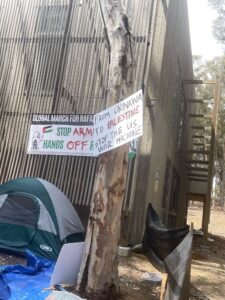
Now that the beautiful anti-genocide encampments in university campuses across the country, including mine at Rutgers-Newark, have been dismantled, allow me for a moment to be suspicious of solidarity.
On the left, Iraq has become a buzzword to talk about U.S. imperialism, U.S. foreign policy. We, Iraqis, our social movements, our feminist movements, our everyday life, us as people, evaporate in a political standpoint that is more interested in clearing its conscience and making sure it stays the center of the story, its analyst, its theorist.
Even in so-called progressive spaces, Iraqis, Palestinians, Arabs, and Muslims are not to be trusted to talk about what is happening to them, about resistance, to explain what this means, what it does. Even as two million Palestinians are being bombed, maimed, and starved.
In the past five years, I have worked on building the Critical Studies of Iraq initiative with a network of feminist activists and scholars, sociologists and anthropologists in Iraq. We have been thinking of what it means to take Iraq as a framework, and not as a case study, to theorize from, and not only about. In the hegemonic global academy in which feminist questions such as: what theory is for, whose interest does it serve?, is never in anyone’s mind, Iraq has been theorized from outside of its borders, from the metropolitan powers that have played a central role in destroying the very possibility — political, structural and infrastructural — of a free and functioning Iraqi intellectual life.
We are reflecting on what theory would look like if we were to decide what we want to theorize about, and how we want to go about it.
This transnational work with friends, comrades, and colleagues in Iraq is my refuge from the academy, from the U.S.
At Rutgers, and in the U.S., during these moments of speechlessness and paralysis, I have also found, on my campus and beyond, people with whom I have organized and discussed the meaning of solidarity in times of fascism and genocide.
What I know is that transnational activism is more important than ever: the necessity to connect the dots between spaces, places, people, to break with this idea of a here and a faraway there that structures the mind of people in this empire. To insist on the fact that we live in one world structured by systems of power — racial, colonial, heteropatriarchal, capitalist — that some, mostly but not exclusively, in the Global Norths benefit from these systems, and some are victims of it, oppressed by it. It means that some live at the expense of others, through their exploitation and oppression.
It means that Gaza, Palestine, Lebanon, Iraq, and Afghanistan, just like Vietnam, are present in the everyday lives of people in the U.S., in its military-industrial complex, in its normalization of police violence, in its anti-Black and anti-immigration racism and in its neocolonial white feminism and so many other aspects of its social, economic, and political life. All the important debates about racial reckoning have to be articulated with imperial reckoning. A serious engagement with the understanding of the relationship between racism, imperialism, and settler-colonialism is needed.
It implies the necessity to de-center U.S. narratives, U.S.-centrism, and center instead the subjectivities, experiences, trajectories of those on the other side of the empire. It implies understanding empire as a structure, not simply as the agency of a criminal nation-state, or a political actor.
As a feminist scholar and educator, it means to interrogate the subject of feminism, to think seriously about what gender and violence mean. Specifically, when thinking through Iraq and Palestine, when we know that Iraqi men, Palestinian men are not considered civilians, humans. The white colonial militaristic framework of depicting our men as “perpetrators of violence” by default. During the invasion and occupation, Iraqi men were considered by the US army as “fighters” by default. But in Iraq, there was at least the “womenandchildren” narrative at play, in Gaza, where most of the victims are women and children, we see that even the problematic “womenandchildren” category does not even stand.
My insistence on the “trans” in transnational is of course a refusal of the “inter” of international that essentializes and homogenizes categories such as nation and in the case of feminist theory and activism the category women. It means to refuse capitalist, white, middle-class frames of solidarity, and to insist on the importance of transcending borders of nation, gender, and sexuality.
It means today, as the U.S.-Israeli war on Iran is still fresh in people’s mind, challenging simplistic and binary anti-imperialist slogans and agendas. Because in moments of struggle, how tempting it is to simplify where we stand, who we are. Understanding empire as structure also means that we can see how authoritarian regimes in the Global Souths have captured anti-imperialist slogans to justify their rule. The anti-feminist, and anti-gender backlashes in Iraq and the region, are done in the name of anti-Western imperialism, and anti-Zionism. Fascism in our contexts is part of this structure, but it also carries its own logic, its own structures.
I want to think of a world where we are all truly connected and in which the integrity of the body–its freedom, its dignity–and the possibility of living a dignified life, with all the structural and infrastructural dimensions that it requires, is at the center of our political and theoretical imagination. This means connecting together the intimate, the personal, the political, the structural, the local, global/transnational. It means doing justice to the multiple dynamics at play, being able to articulate and hold several levels of critique together. Comparing without equating.
It is absolutely essential to continue building transnational spaces where we can collectively imagine the world we want to live in, not only the one that we are standing against.
As a daughter of Iraqi refugees, I realized early in my life that knowledge making and activism have not only been about imagining emancipatory futures but also about learning how to mourn, to commemorate, to remember. Thinking of Iraq, Afghanistan, Palestine, Congo, Sudan and beyond: I find myself obliged to break with the mode of academia and find true meaning in poetry. I end with these two verses of an old Arab melody called al-Rukbaniyah recited in the Iraqi dialect that expresses the desire for peace, and the fear of being forgotten because of distance:
خذ يا نسيم السحر مني سلام الهم
Take oh morning breeze my salaam to them
واحچيلهم حالتي وباللطف عاتبهم
Tell them about my situation, and with kindness make this reproach
ما رضيت منهم بدل ما سمعت عاذلهم
I never accepted anyone else, I never listened to their naysayers
لا يكون بعدي انا يصير السبب ينسون
May it not be my distance the reason they forget
*
Against the “Matrix of Administrative Domination”
Sang Hea Kil (San José State University)
I am the first full tenured professor fired for anti-genocide and pro-Palestine speech (July 2025) and first tenured faculty to be reinstated (June 2026) at the “Justice” Studies Department at San José State University. I am the 2026 recipient of the “Courageous Voices” Grant from the Scholars for Social Justice. And I am winner of 2021 Outstanding Academic Title: Media and Communication for the Choice award (the publishing unit of the Association of College and Research Libraries, a division of the American Library Association) for “Covering the Border War: How the News Media Creates Crime, Race, Nation, and the USA-Mexico Divide” (Lexington Press). I am currently the co-chair of California Scholars for Academic Freedom and trichair of the Asian Pacific Islander Desi caucus of my faculty union, the California Faculty Association that covers almost 30,000 faculty in the California State University System.
Frankly, my targeting has destroyed my research. When you get targeted for termination by your institution, it puts a mark on you that stays with you. I was working on a book that I now feel I must abandon. Instead, I have switched gears to focus on a book about what happened to me, framing it around the attacks on free speech, academic freedom, student protest movement, and the collaborations I see between the higher education administrators and MAGA to target and destroy job protections like tenure while silencing campus critics of the Zionism and the genocide of the Palestinian people by Israel (with the help of the USA).
Following my suspension by SJSU administrators, I mentioned in The Radical Teacher (2024) that there exists a “Matrix of Administrative Domination” silencing faculty to submission. As noted during one of the roundtables organized by the Coalition for Action in Higher Ed (CAHE), I noticed that Asian groups and organizations were slow to no to ICE and slow to no to genocide. And I think that in this historical moment, that is really shameful. I used the term “Matrix of Administration Domination” to make sense of this silence from faculty groups on my campus, like my campus faculty union CFA-SJSU and my academic senate. Neither have come out to support me robustly and neither have used the word ‘genocide’ to describe what is happening to the Palestinians. I came up with some analysis on why this occurs more recently. I have been thinking about Mbembe’s (2003) ‘necropolitics’ alongside my term ‘dead faculty walking’ that I use to describe the lack of solidarity by colleagues when one gets nailed for speaking about Palestine. His core argument is that the colonizer decides who gets to live and who gets to die. But I think there is a secondary violence that is necropolitical toward allies of Palestine who choose to speak out. This is why we are treated as if we do not exist when we are targeted, as we are marginalized with silence. And those that treat us with silence are doing the necropolitical work for the colonizer in ensuring that Palestinians die and those that speak out get marginalized, punished or fired. My campus faculty leadership has done this to me as well as all the major Asian organizations that could have spoken up for me but remained silent. They are all doing the colonizer’s work of silencing the genocide.
Now that SJSU made me make history twice (by being fired and then reinstated), I expect that I will be targeted and surveilled like never before, both in my private life as well as on campus and in the classroom. I teach a comparative human rights class that analyzes the USA-Mexico border and the Israel-Palestine border and I expect that now Zionists will organize students to attend my class and make claims of anti-Zionism and antisemitism to try to get me fired again. I hope I’m wrong but I doubt it.
Look, we are losing the battle against the team up between MAGA and Zion. I call it MAGAZion for shorthand. I only expect more targeting, harm and injury to occur to me and others who continue to speak up about what is going on in the world. I see a hemispheric, new colonial realignment happening right now where MAGA colonizes the West and Zion colonizes the East. We have already seen what is happening to Venezuela and Cuba with more coming in the West, and Zionism has been open about the Greater Israel Project which we can see in the West Bank and southern Lebanon with more wars and occupations coming. And this teamup is trying to solidify its hold with National Security Presidential Memorandum/NSPM-7 (titled “Countering Domestic Terrorism and Organized Political Violence” issued in September 2025) and the National Defense Authorization Act, which just passed the House in May 2026, where Section 219, proposes expanded collaboration between the two militaries and hide the huge amounts of taxpayer support for Israel and its expansionist desires. And let me be clear, MAGA did not come out of nowhere. MAGA is a bipartisan creation and was born out of both Democrats and Republicans alike investing in neoliberal white supremacy by giving rise to multinational corporations, sealing global trade deals that make rich countries richer and poor countries poorer, and eroding the middle class and criminalizing the poor/ working poor in our nation. On top of this dismal picture, we now have tech heads acting like cult leaders who want corporations to ‘not hire humans’ and collaborate in the security apparatus needed to squash any resistance against this MAGAZion hemispheric realignment. So our geopolitical trajectory looks grim, unless we unite, organize and fight this neoliberal white supremacy together. So my hope is that in 2028, we answer the United Auto Workers call for general strike and that we stop the capitalist machinery by withholding our labor across all job sectors for a sustained and prolonged period to show that we can pushback against this new global colonialism that wants us all to be surplus workers, criminalize our attempt to survive a more brutal economy, and make money by putting us in detention centers or prisons.
Bill Gates predicted that the rise of AI would replace our education system in 10 years. I wish I could say I disagree with him. I do think it will take more like 20 years. But knowing this, I plan to go down fighting as an educational worker in Higher Ed. I will continue to try to make my union stronger and better at doing strikes. I made history in my union with the signature of 100 fellow CFA members by getting a statewide bylaws change to establish a strike fund while I was targeted, among many other reforms I worked with fellow faculty to pass at our assemblies. So I will continue to say, if you do not have a union at your job, form one now. And if you have a union already, get involved and make it more democratic and stronger for the battles ahead. I will continue to speak out and organize against the neoliberal transformations in Higher Ed that uphold white supremacy. And I will continue to speak up and write against this MAGAZion teamup that is neocolonial, neoliberal white supremacy. My hope is that we will fight and organize to divest from death, destruction and unjust wars.
*
Teaching about Genocide in Korea
John Eperjesi (Kyung Hee University)
In the summer of 2006, I made an abrupt decision to move from Portland, Oregon, where I was an adjunct professor at Portland State University, to South Korea. My decision to move here was abrupt, but my desire to leave the US had been building for several years.
I got my Ph.D. in the Literary and Cultural Theory program (LCT) at Carnegie Mellon University in 2000, and published my book, The Imperialist Imaginary: Visions of Asia and the Pacific in American Culture, in 2005, but did not get many interviews at the MLA. My academic work was at the intersection of American Studies, Asian American Studies, and Transpacific Studies, or what is now called the Oceanic or Blue Humanities, which was a niche field, good for publishing, not good for getting a decent job. I was overworked and underpaid and had no time to write; the future looked bleak.
On top of all that, lies about weapons of mass destruction were being used to justify the War on Terror, and the images of tortured prisoners at Abu Ghraib were horrifying. Seeing Bush, Cheney, and Rumsfeld in the news every day was making me sick. My mom had been seduced by Rush Limbaugh and Fox News. We stopped talking to each other, just like high school. It was time to leave.
One of my goals in moving to South Korea was to learn more about the Korean War, both for personal reasons—my father was a Korean War veteran—and professional reasons. Americanists have been fixated on the US war in Vietnam, but there wasn’t much work on the Korean War, the “forgotten war.” When I moved here, transpacific interpretations of the Korean War were emerging, such as Jodi Kim’s Ends of Empire (2004). And once in Korea, it finally registered that the Korean War isn’t over. I learned about the Jeju April 3 Incident, as it is officially called, one of the worst civilian massacres in twentieth century Asian history. The uprising and massacre on Jeju at the dawn of the Cold War resembles in many ways what Israel, with the financial, military, and ideological support of the US, is doing in Gaza now—collective punishment, scorched earth, mass displacement, internment camps, torture, sexual violence—in order to stop a liberation movement. In American Involvement in the Jeju April 3 Incident (2021), Heo Ho-joon argues that what happened on Jeju between 1948 and 1954 can be interpreted as a genocide.
For the past thirty years, my research and teaching, both in the US and South Korea, have been guided by Edward Said. My book was inspired by, and responds to Orientalism and Culture and Imperialism, focusing on the 1890s, the period when the US colonized Guåhan/Guam, Hawai’i, the Philippines, and Sāmoa, in order to secure access to the mythical China market, keep a rising Japanese empire in check, and thus help resolve the economic crisis of overproduction. The American Pacific was a regional imaginary that provided a “spatial fix” for capital. From the perspective of the US empire, the Orient refers primarily to East Asia—China, Japan, Korea, and Vietnam—usually in that order, which is entirely different from the Orient discussed by Said in Orientalism, in reference to the Middle East/West Asia and North Africa.
I was always aware of Said’s writing about and activism for Palestine, but this was in my peripheral vision, on the margins, as my focus was on the other side of Asia. I knew scholars who were passionate about Palestinian struggles, and I admired their fierce engagement, but I never took the time to understand the history, or how this history was being violently played out in the present. I had my academic specialization and spatialization, Orientalism in East Asia, and they had theirs, Orientalism in …
Where was Palestine again?
Everything changed after October 2023. Before this, I did not know what Nakba meant. I did not know anything about the Balfour Declaration or the 2014 Gaza War aka Operation Protective Edge (or any of the aggressively named Operations), or the Great March of Return in 2018. I had seen the word Intifada and images of children throwing rocks at tanks countless times but did not know any details of Palestinian resistance to the occupation. I had never read any Palestinian literature.
And then social media exploded. On the one hand, there were the horrifying images all day, every day of Palestinian children buried under rubble, of bodies torn open by bombs, of amputated limbs, of weeping parents, of shattered families, a reality too terrible to witness, a “live-streamed genocide,” as secretary-general of Amnesty International, Agnes Callamard, described it.
Meanwhile IDF soldiers posted mocking videos of themselves in Gaza holding up women’s lingerie, playing with children’s toys, reading books in libraries, before blowing everything up, a “joyful flaunting of annihilatory violence” as Eyal Weizman puts it in Ungrounding: The Architecture of Genocide (2026).
In One Day, Everyone Will Have Been Against This (2025), Omar El Akkad asks, “How does one live, hearing the screams, bearing witness to the bodies? How does anything else matter?” How does one go into the classroom to teach, “hearing the screams, bearing witness to the bodies?”
As an Americanist, the ongoing history of ethnic cleansing, settler colonialism, and apartheid in Palestine is all too familiar because it doubles, and borrows from, the formation of the US as a continental empire in the nineteenth century. As Naomi Klein writes in Doppelganger (2023), “Many of Zionism’s basic rationales were thinly veiled Judaizations of core Christian colonial conceptions.” The basic myths that anchor settler colonialism in the US—Manifest Destiny, Virgin Land, taming the wild frontier—were repackaged by Zionists as “land bequeathed to the Jews by divine right,” “A land without people for a people without land,” and “making the desert bloom.” Israel often points to the use of violence in US history, from Native American genocide to Hiroshima and Nagasaki, to justify what they are doing in Gaza.
In “Gaza as World Event,” Nancy Fraser argues that Israel’s genocide in Gaza “is an epochal turning point that also serves to reveal, and so to signify, the nature of the times.” This world event is reflected in many of the texts I teach in my courses on the environmental humanities.
John Steinbeck’s The Grapes of Wrath (1939), for example, is a story of refugees displaced from their homes in the face of fascist state violence. At the end of the novel, the migrant workers are stuck in a makeshift camp as winter is approaching. Cold rain has been pouring down for several days, inundating the camp and turning everything to mud. This scene is based on floods in Visalia, California in 1937 where four thousand migrant worker families were flooded out of their tents and starved while smallpox spread through the camps. In his biography of Steinbeck, Mad at the World (2020), William Souder writes: “Word was that thousands of families were starving. But what enraged Steinbeck were the active efforts of the growers and their allies to block relief efforts.” As I was teaching this section of the novel, Winter Storm Byron was flooding displacement camps in Gaza while Israel was restricting the entrance of shelter materials and other forms of humanitarian aid.
But Dust Bowl refugees in the novel, like Palestinians in Gaza, are not simply helpless victims. Just as in The Grapes of Wrath, where migrant workers hold a dance in the refugee camp as a source of resilience and resistance to state violence, Camp Breakerz in Gaza was founded in 2004 by brothers Moh Ghraiz and Ahmed Alghariz, using hip hop dance as a form of therapy to help young people survive, both physically and emotionally. After their studio was bombed in 2009, Camp Breakerz built a new studio in Nuseirat Refugee Camp.
More recently, I’ve been teaching the first chapter of Kim Stanley Robinson’s The Ministry for the Future (2020), a science fiction novel that explores the intersection of capitalism, colonialism, and climate breakdown. Our discussion of the first chapter usually focuses on some of the keywords in the environmental humanities: slow violence, climate justice, neocolonialism, Gothic Anthropocene. But when I taught it at the end of the semester in the fall of 2023, it hit very differently. It became a story of genocide as the mood and imagery of the novel mirrored the horrific violence in Gaza. The complete siege on the Gaza strip by Israel began to merge with the complete siege of Utter Pradesh by the high wet-bulb temperature.
When I teach this dystopian first chapter, I always pair it with chapter eighty-five to expose students to the utopian dimensions of the novel. Chapter eighty-five is a roll call for an online meeting of environmental activist groups from around the world who are fighting for the biosphere, for present and future generations of human and nonhuman life, on this planet. The chapter is only four pages long but lists hundreds of non-fictional groups active in the first decades of the twenty-first century, affirming Rebecca Solnit’s argument about hope in Hope in the Dark (2004): “What we dream of is already present in the world.” I can imagine a similar chapter in the form of an online meeting of the global solidarity movement for Palestine.
Next semester, I’m planning to teach several of the stories included in Gaza Writes Back: Short Stories from Young Writers in Gaza (2013), edited by Dr. Refaat Alareer, a Palestinian writer, translator, and activist who taught English literature in Gaza. These stories were written in the aftermath of Operation Cast Lead, a military offensive Israel launched on Gaza between December 27, 2008 and January 18, 2009, which killed around 1,400 people, and destroyed more than 46,000 homes. Most of the stories were written by university students studying English, much like my students at Kyung Hee University. As Alareer writes in his introduction, the collection demonstrates “that telling stories is an act of life, that telling stories is resistance, and that telling stories shapes our memories.”
On December 9, 2023, at the age of 44, Alareer was murdered by an Israeli airstrike that also killed his brother, sister, and four of his nephews. In 2014, his brother Mohammed was killed by an airstrike during Operation Protective Edge, at age 31, which made him the 26th person in his family to be killed by Israel. In Gaza Unsilenced (2015), Alareer writes, “To be Palestinian from Gaza means that you can be under attack from Israel at any time. It means that you are just a postponed target, and all you can do is wait to face your destiny. This is how we live in Gaza, both with and without war.”
Five weeks before his murder, he shared the poem “If I Must Die”:
If I must die,
you must live
to tell my story
to sell my things
to buy a piece of cloth
and some strings,
(make it white with a long tail)
so that a child, somewhere in Gaza
while looking heaven in the eye
awaiting his dad who left in a blaze—
and bid no one farewell
not even to his flesh
not even to himself—
sees the kite, my kite you made, flying up above
and thinks for a moment an angel is there
bringing back love
If I must die
Let it bring hope
Let it be a tale
For Edward Said too, telling stories, the power to narrate, is an act of life, which is especially urgent given the fact that, as he wrote in 1979 in The Question of Palestine, “[t]oday Palestine does not exist, except as memory, or more importantly, as an idea, a political and human experience, and an act of sustained popular will.” It is our job as teachers and students to sustain that will.
*