Ray Matsumoto explores how Imagine 21 uses theater to confront wartime violence and inherited guilt.
Ray Matsumoto
During my sophomore year of undergraduate studies, my father disclosed that my grandfather was Korean and had migrated to Japan shortly before Korea’s liberation in 1945. Given that my grandfather was already suffering from dementia at that time, I was unable to inquire about his experiences directly. Nevertheless, this revelation compelled me to travel to South Korea, where I visited the Seodaemun Prison History Hall, which once held Korean independence activists during Japanese colonial rule. The experience was profoundly moving. I felt a sense of shame regarding my ignorance of Japan’s colonization of Korea and experienced discomfort as a Japanese individual amidst Korean visitors. As my college friend translated the exhibit descriptions, I became deeply engrossed in the story of Yu Gwan-sun, a teenage Korean activist, revered today as the “Korean Joan of Arc,” who opposed Japanese rule and died under severe torture. In Seodaemun Prison, Yu was subjected to brutal torture, resulting in the rupture of her bladder and her death at the age of 17. Learning of her suffering—particularly the haunting details of her final days—rendered me speechless before her portrait.
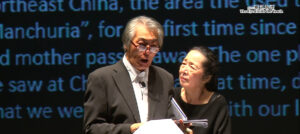
The experience left me feeling guilty. I realized I lacked an understanding of history, linguistic skills, and theoretical frameworks to grasp my place in this complex history. Determined to improve, I looked for ways to deepen my knowledge of modern Japan and the Asia-Pacific War. This search led me to Pacific Atrocities Education (PAE), a non-profit organization that runs public history projects centered on Japanese brutality during World War II. In the summer of 2022, I became a research fellow at PAE, where I had the opportunity to interview Watanabe Yoshiji (渡辺義治) and Yokoi Kazuko (横井量子), a married independent theater duo who perform under the name Imagine 21. I had first learned about Imagine 21’s work through a recording of Hitomi: The Eyes Hold the Truth (ひとみ―真実はひとみのなかにある), one of their theater productions based on testimonies by survivors of Imperial Japanese military sexual slavery, or the so-called “comfort women.” Their performance was unlike anything I had ever seen before. In June 2022, I visited Watanabe and Yokoi at their residence in Tokyo for a recorded interview. Feeling a great sense of anxiety, I could not have imagined how this encounter would become so transformative for my life.
Watanabe Yoshiji and Yokoi Kazuko
Watanabe was born in Gifu Prefecture in 1947. His father, Watanabe Aiji, was a former Manchukuo Army officer convicted of Class-C war crimes for ordering the executions of Chinese prisoners of war. During the 1945 Soviet attack on Manchuria, Aiji was among those in the Japanese Army who secretly fled to the mainland and abandoned Japanese civilians. Despite being born in postwar Japan, violence shaped Watanabe’s childhood. His father often erupted in rage, throwing dishes, flipping the dining table, and, at his worst, dragging Watanabe’s mother through the house by her hair. The memory of his mother saying, “I am an animal. I want to become an animal (自分は動物だ。動物になる)!” while crying to young Watanabe, etched itself in his mind. Desperate to escape this life, Watanabe moved to Tokyo shortly after university to pursue his passion for theater. However, Watanabe could not break free from his family’s violence, as shown when Watanabe’s mother sent him a letter written in her own blood that said, “You and I are mother and son. Blood runs through us that can never be severed. You are mine” (あなたと私は親子、切ってもきれない血が流れているのです。貴方は私のもの). Suffering from clinical depression, Watanabe’s mother eventually took her own life when Watanabe was 37.
Yokoi Kazuko, born in 1946, enjoyed a privileged childhood in Tokyo compared to Watanabe. Her father, considered unfit for military service during the war, became a merchant supplying goods to the Japanese Army. While most of the country faced hardships, Yokoi’s family prospered. Not only did her parents acquire enough wealth to build a new home, but her father also frequently visited the Geisha district. Although she was born after the war, Yokoi herself greatly benefited from this wealth. In Hitomi, Yokoi describes an early childhood memory at age four of walking to Shibuya Station with her older sister and seeing disabled Japanese veterans for the first time. She wore an expensive yellow dress, while the veterans, in contrast, wore white kimonos and army caps and often played an accordion or harmonica to collect donations. While these veterans struggled to survive, few people acknowledged them, walking past as if they did not exist. Later learning that many of these veterans were Koreans denied military pensions and unable to repatriate, Yokoi felt ashamed of her ignorance and her family’s complicity in colonial violence.
Entangled Temporalities
Although I have been engaged with Watanabe and Yokoi’s work for nearly four years, I still find it difficult to articulate the power and moral importance of their art. Seeking words to describe their ideas, I turned to Walter Benjamin’s “On the Concept of History.” To me, Watanabe and Yokoi embody Benjamin’s “Angel of History.” Like the angel whose face is turned toward the wreckage of the past as the “storm of progress” pushes him forward, Watanabe and Yokoi confront Japan’s violent history, striving to recover the voices of those lost during wartime atrocities. Echoing Benjamin’s warning that the storm of progress keeps moving forward relentlessly, Japan’s pursuit of progress both perpetuates colonial violence and conceals its imperial legacies. Like the angel, Watanabe and Yokoi bear witness to this entanglement of temporalities.
In his writing, Benjamin introduces the concept of “messianic time” as a sudden interruption of the homogeneous, progressive, and modernist view of history. He famously describes this as a moment when one “take[s] control of a memory, as it flashes in a moment of danger.” While scholars have long debated how to interpret this text, I argue that Watanabe and Yokoi’s narratives illustrate how the past erupts into the present as a call for moral and historical reckoning. In 1991, seven years after Watanabe’s mother’s suicide, the couple traveled to Northeast China (formerly Manchuria), where his family had once lived during Imperial Japanese rule. From the moment they stepped out of the airport in Harbin, they felt the heavy weight of history pressing down on them. A sudden thunderclap echoed across the sky, leaving Watanabe frozen in fear. In his words, the moment felt as if the spirits of Japan’s victims were confronting him, asking, “Are you Watanabe Aiji’s son (お前は渡辺愛治の息子か)?” They only realized later that the day was September 18, the anniversary of the 1931 Mukden Incident.
Two days later, on a train to Mishan, Watanabe and Yokoi experienced another moment of historical rupture. While eating breakfast in the dining car, a Chinese chef abruptly confronted them, asking, “You are Japanese, correct? Countless people from this region were abducted and taken to Japan, as well as to Unit 731 [during the war]. To this day, we do not know what happened to them. Tell me, how do you feel as Japanese people knowing of this (あんたたちは、日本人だろ、この辺りからも、たくさんの中国人が『七三一』や日本に拉致され、未だに帰ってこない。日本人として、どう思う)?” For the first time, Watanabe and Yokoi directly faced the unresolved anguish of Chinese victims of Japanese imperialism.
Near the end of their trip, Watanabe and Yokoi visited the Museum of the Imperial Palace of Manchukuo in Changchun, once home to Emperor Puyi. There, a photograph caught Watanabe’s attention: a Japanese soldier smiling as he posed with a bloodied sword behind a row of severed Chinese heads. Possessed by the image, Watanabe saw his father’s face in the soldier’s grin. Flashbacks from his childhood flooded Watanabe’s mind. He remembered his father polishing the sword he had smuggled home from Manchuria, which he concealed in the family bedroom, and his father awakening in panic from nightmares, haunted by the innocent victims he had killed. In Watanabe’s words,
My father must have been haunted in his sleep, as his victims confronted him during the night, awakening him from rest and tormenting him by saying, “Give me back my life! I will not leave until it is returned!”… Not a single day passed without our family being haunted by the resentment, sorrow, anger, and suffering of these young men. Their anguished voices overwhelmed us: “You survived instead of us—and you dare to seek happiness? We cannot allow such nonsense!”… This was precisely the source of my anxiety, dread, and fear. Living each day in an environment of anxiety and melancholy has shaped my character today. Perhaps it was the same fear that afflicted Japanese soldiers on the front lines—the “spirit” that had lost all reason to live. Even after the war, our family continued to fight on the “battlefield.”
父がうなされていたのは、きっとこの人たちが、父の寝込みを襲い、眠りから引きずり出し、『私の命を返せ、返すまで、あなたの側を離れない…』と父をゆさぶっていたのだ。私たち家族の生活は、この若者たちの怨み、哀しみ、怒り、苦しみのその声に覆われた日々だったのだ。『自分たちだけ生き残って、そして幸せになろうなんて許せない…。』それこそが私にずっと付きまとう不安と怯え、怖れの根幹だったのだ。あの我家の強張った緊張と不機嫌な沈黙に支配される不安な日々、その日々が私を形づくった。その侵略戦争の戦場に立つ、日本兵の不安そのものかもしれない、生きる大義を失った『生』…。私と私の家族は戦後も、その『戦場』を生きていたのだと思う。
These moments in China that Watanabe experienced evoke Benjamin’s concept of messianic time, representing a rupture in the linear progression of history in which the past suddenly emerges in the present, offering an opportunity for redemption. For Watanabe, recalling his father’s violence and the suffering endured by Japan’s victims merged into a single, transformative, dialectical vision. This awakening became both moral and artistic, leading him and Yokoi to establish Imagine 21. Consequently, redemption involves not only rescuing silenced voices of victims of Japanese imperialism but also confronting and atoning for their own inherited guilt and responsibility as second-generation perpetrators.
Theater as Redemption
For Watanabe and Yokoi, theater serves as an important medium for representing, confronting, and atoning for their inherited guilt. Between 1991 and 2026, they have written and performed three works, each addressing specific issues related to Japanese imperialism and wartime violence. In 1993, Watanabe and Yokoi produced Reunion: Silence and Truth (再会―沈黙と真実), which tells the story of a Japanese woman abandoned in Manchuria after the 1945 Soviet attack who reunites with her husband in postwar Japan. In 2007, they created Nanjing Sorrow: December in Hell (哀しみの南京―地獄のDECEMBER), a historical retelling of the violent events of the 1937 Nanjing Massacre, based on testimonies from Chinese survivors and former Japanese Army members. Three years later, in 2010, they produced their final piece, Hitomi, a recreation of testimonies from Korean and Chinese comfort women survivors.
In each of these productions, Watanabe and Yokoi deliver powerful performances by interweaving historical and theatrical representation with self-reflection. While their stories focus on survivors, victims, and perpetrators, each piece also engages with Watanabe and Yokoi’s own identities, as seen in the “confession” (告白)—a scene in each play in which they acknowledge their inherited guilt through deep reflection on their childhood and young adult memories. This moment of vulnerability is essential to their act of redemption and is especially reflected in their language of atonement, which involves recognizing and choosing to live with this guilt for the rest of their lives, rather than seeking forgiveness or absolution. As Watanabe states in Nanjing Sorrow,
It was not just me. My whole family carried a terrible sin. I constantly believed that we would never find happiness—or more accurately, we must never be happy. One day, our reckoning would come. … The Japanese people—no matter how much wealth they have—will never know true happiness as long as Chinese and other Asian people continue to remember. If any Japanese person claims to be happy, it is merely an illusion—empty and meaningless—like an Adabana, a flower that never bears fruit. How do you plan to face Japan’s past? No! Rather, how am I going to face it! It is important to question what is accepted as fact. … But what matters even more is to hold deep within ourselves, and truly feel, the sorrow, suffering, and despair of humanity. … As a “sinner,” how can I atone for my “crimes”? Hell is my home. Hell is my very life.
私のみならず、私たち家族は何か大きな『罪』を抱えている。そして決して幸せにならない、いや幸せになってはならない。いつかその『罪』の報いを受ける日が必ずくる呪われた家族…(中略)日本人はいくらお金があっても、幸せに離れないであろう…。中国、アジアの人々の怨念が消えない限り。今、幸せな人がいるとしたら、それは、徒花にすぎない…。貴方は『日本の過去』をどうみつめたいのですか?…。いえ、私自身…どうみつめたいのか…‼ 事実を争うことも大事だ。(中略)けれど、もっと大事な事は人間の哀しみ、苦しみ、絶望の気持ち、そういう心を豊かに持ち感じえる…(中略)『罪人』の私、その『罪』をどう償うのか。地獄こそ、我が住家。地獄こそ、我が生命。
I had the chance to see Imagine 21 perform in September 2025, and its emotional power still resonates with me. Once again, Benjamin’s language offers a helpful framework for analysis. In Thesis X, Benjamin warns that faith in progress blinds us to catastrophe. Many theatrical and artistic forms reproduce this illusion of historical progress, closure, and continuity, but Imagine 21 challenges this through fragmentation and interruption, revealing the violence hidden beneath narratives of modernity. Each performance becomes a moment of temporal rupture in which the past clashes with the present, forcing viewers to confront their own place in history in a continual struggle for justice and meaning. In other words, by viewing performance as a site of temporal disruption, Imagine 21 makes visible the unresolved suffering of the past and points toward the possibility of historical atonement—not through closure, but through the ongoing reactivation of memory in the present. This view of intertwined temporalities requires more than just engaging with history and artistic representation as objects of study; it also demands deep reflection on positionality, examining how we are implicated in legacies of violence. While we may aspire to Benjamin’s Angel of History, witnessing destruction while longing for redemption, we must also acknowledge that we are part of the very storm that perpetuates suffering and erasure. Therefore, the historian’s task of “redemption” should not be seen as an act of authority but as one of complicity and responsibility.
*****
Shortly after my grandfather’s death in April 2024, I finally gathered the courage to ask my Japanese grandmother about my Korean heritage. However, this was not the first time I had asked a relative about this topic. Soon after I learned about my Korean background through my father, I mentioned it to my uncle, my father’s younger brother. To my surprise, he immediately changed the subject. It was because my younger cousins were in the same room, and he did not want them to know. Ever since, I have felt too nervous to bring it up with my family. Sadly, my grandmother would not tell me anything either. She claimed she knew little about my grandfather’s Korean background, though I have my doubts. Unsure how to respond, I said nothing more.
While I realized the challenge of confronting my Korean heritage, it pales in comparison to the struggles of Watanabe and Yokoi. Their relentless confrontation of the past has shaped my understanding of history. Coming to terms with identity is not simply an act of self-recognition, but a continual negotiation with history itself: with the silences I inherited, the guilt I carry, and the empathy I strive to cultivate. It means accepting that memory is never complete and that understanding one’s past is an ongoing process. Living with this awareness is messy and incomplete, but maybe that is the point. The act of remembering—of confronting what we were taught to hide—becomes its own form of resistance.
References:
Benjamin, Walter. On the Concept of History. Translated by Dennis Redmond. 2005. Marxists Internet Archive. Accessed July 13, 2026. https://www.marxists.org/reference/archive/benjamin/1940/history.htm
Watanabe, Yoshiji, and Yokoi Kazuko. Hitomi: The Eyes Hold the Truth. Published by the authors, 2010.
———. Nanjing Sorrow: December in Hell. Published by the authors, 2007.
———. Reunion: Silence and Truth. Published by the authors, 1993.
*
Ray Matsumoto is a PhD student in History (Japan Field) at UCLA. His research explores transnational colonial and war memory in Asia, focusing on discourses of intergenerational guilt, responsibility, and implication. As a Japanese national with Korean heritage and an international educational background, his positionality is central to his research methodology.