Last year marked the eightieth anniversary of the atomic bombings of Hiroshima and Nagasaki. It also marked a new era in nuclear dangers, with the imminent expiration of the last of the strategic nuclear weapons treaties (New START). While the Treaty on the Non-Proliferation of Nuclear Weapons has no expiration date, the associated commitment to a moratorium on tests by the signatory nations appears to be at risk of faltering. The 2025 strikes on Iran’s nuclear sites by Israel and the United States further imperil nonproliferation efforts by making transparency a potential risk, a situation compounded in 2026 by rhetoric threatening civilization-level death and other signs of unpredictable judgment.1
The memory of those atomic bombings eight decades ago has remained fraught in Japan, with survivors of the attacks—hibakusha—on the one hand facing discrimination, and on the other hand finding their perspectives caught up in national and international politics, appropriated for ends they do not support.2 Meanwhile, even as worries about some country finally breaking the “nuclear taboo” have escalated, the Japanese government has refused to sign onto the United Nations’ Treaty on the Prohibition of Nuclear Weapons.3
The gap between the urgent “lessons” of this past’s nearly incommunicable experience and the realities of continuing nuclear politics detached from any such assessment becomes ever clearer when considered against the ways in which the Japanese and American security states have worked to suppress objections to nuclear dangers. The legacy of the two nuclear attacks is intertwined with constraints on the exercise of postwar democracy and decades of extensive American involvement—overt and covert—in Japanese domestic politics.4 I will consider the legacy of one major confrontation—protests against the arrival of the nuclear powered, and nuclear armed USS Enterprise in Sasebo, Nagasaki prefecture in January 1968—as a moment deeply embedded within this longer history. Reframing this legacy against demands for popular sovereignty and political debate shifts the terms of discussion from a frozen moment of hellish attack to a long-deferred question of democratic accountability of states to their publics.
Discussions of wartime experiences necessarily involve questions inconvenient to state political objectives. During the Allied Occupation of Japan, discussions and representations of the atomic bombings were specifically subject to censorship, and even undercover police surveillance once the Korean War began.5 Commitments to promoting a vigorous postwar democracy were attenuated for strategic concerns, and by what political scientist and Occupation Government Section staffer John M. Maki described as the “identity of interest between the Occupation and the government,” a situation created by the “decision to act through [the existing] Japanese government.”6 Despite early purges of militarists, the postwar state managed to preserve major portions of the Imperial state and its personnel with the assistance of the Occupation, colluding so as to limit popular sovereignty.7
Nuclear and strategic policy maintained and obscured this political legacy. The end year of the Occupation in 1952 coincided with the first Hydrogen Bomb test, and the ongoing Korean War. Signed in 1951, the Peace Treaty ending the Occupation was coupled with a Security Treaty that put Japan squarely within American strategic planning, securing basing rights, transit, and continuing extensive support for America’s cold and hot wars—and thereby made Japan a potential target should nuclear warfare eventuate.8 In contrast to Japanese national governmental acquiescence and accommodation, successive Hiroshima City mayors from 1947 would issue Peace Declarations on the anniversary of the August 6, 1945 bombing, and, beginning in September of 1968, would write directly to countries conducting nuclear tests to convey their opposition.9
Although the postwar constitution “renounced war as a sovereign right of the nation and the threat or use of force as means of settling international disputes,” daily life after the Allied Occupation was closely bound to Asian wars: war procurements during both the Korean and ongoing Vietnam Wars were crucial in inaugurating economic recovery and high growth, in turn supporting the U.S.-favored ruling party.10 The Korean War and Vietnam War also involved Japan directly, via two large naval bases, six air bases, and over 140 smaller bases, logistic depots, hospitals, and communication facilities. Another 80 were on Okinawa, which had remained under American governance; the first troops dispatched to Vietnam came directly from Okinawa, with Kadena Air Force Base going from sporadic use to full bombing sorties beginning in February of 1968.11 Strategic technology transfers and other support boosted the growing electronics industry.12 Hot and Cold Wars alike link present-day security with the recent imperial past: American Occupation planning sought to return Japan to economic regional preeminence similar to that of its wartime Greater East Asia Co-Prosperity Sphere, a goal finally realized in the 1960s through Vietnam-era economic involvements.13
The gulf between popular support for peace and denuclearization and a daily life deeply tied to war would come to the fore with the January 1968 visit of the nuclear-powered carrier USS Enterprise to the naval base US Fleet Activities Sasebo, Nagasaki prefecture. For years, American strategists had expressed frustration with the troublesome resistance of the Japanese public to nuclear warfare, sometimes described as their curious “nuclear allergy,” and annoyance with the limits such opinions had on deployments involving bases in Japan.14 To promote compliance, Prime Minister Satō Eisaku had begun a multiyear campaign to increase public “defense consciousness,” but continuing wars and threats made such goals fraught at best.
A Department of State declassified memo on the visit made the intertwined objectives for the Enterprise visit explicitly clear:
The longer range political reason for the visit is our desire to involve Japan increasingly in our Far East defense posture… we also see some advantage in conditioning the Japanese to military nuclear matters since a solution to the Okinawa problem may well entail returning the island to Japanese administration while continuing to store nuclear weapons at our bases.15
Prime Minister Satō had publicly called for the reversion of Okinawa to Japan while campaigning in 1964, and in a highly-publicized visit to Okinawa in 1965 declared that Japan’s postwar era would not be over until Okinawa was restored.16 Expectations were thus raised following his November 1967 visit to Washington D.C. and meeting with President Johnson that progress to reversion might soon be seen.17 Protests at Haneda Airport sought to impede his departure, and to somehow ignite the underlying and potentially explosive issues involved, including active warmaking from American bases and especially of the assumed but scrupulously unacknowledged presence of nuclear weapons.18 The upcoming visit of the Enterprise in turn raised these stakes significantly.
The Japanese government had long maintained a declared policy of prohibiting the “introduction” of nuclear weapons, producing public suspicions over the improbability that, for example, American ships docking at Japanese bases would have been purged of such weapons. The negotiations for the return of Okinawa raised the issue anew, as reversion would, according to Satō, make it “on par with the mainland,” thereby begging the question again as to the nature of those arrangements.19 In the context of the government’s push to increase the public’s “defense consciousness,” and possible Okinawan reversion, the visit of the USS Enterprise “had given visit [the] character of [a] deliberate effort by Sato government to overcome Japan’s ‘nuclear allergy,’” according to the U.S. Ambassador to Japan, U. Alexis Johnson, that is, to get the public to tacitly accede to nuclear weapons in both mainland ports and post-reversion Okinawa.20
A number of groups planned to oppose the visit of the Enterprise with a large demonstration at the naval base in Sasebo, again in the hopes of triggering a broader public opposition—to nuclear weapons, to the Security Treaty (up for renewal again in 1970), and to the deep involvement of Japan in hot and cold wars and the consequent threat of a conflagration. Japanese and U.S. officials were however sanguine about the situation. Prior confrontations such as in November of 1967 had met with public disapproval, while earlier regular visits of nuclear powered attack submarines (SSNs) since 1964 had apparently been successful in desensitizing the public.21 The Mayor of Sasebo, Tsuji Ichizō, had visited Ambassador Johnson and had promised that “his police and most of the townspeople were prepared to give the [student protesters] a warm welcome,” and asked for 48 hours’ notice to assist in billeting the “several thousand police reserves that he plans to mobilize.”22
Most of Ambassador Johnson’s January 17 telegram to the Secretary of State was dictated prior to protester-police confrontations. He expresses concern that “sensational press treatment that may well be given to accounts of violence instigated by a very small handful of extremist students who enjoy no substantial support…” He added, “[the] fact that they have obtained little or no popular or press support of any kind has encouraged police to take a harder line with them. [The Government of Japan] has mobilized in Sasebo several thousand riot police from all over Japan…”23
Ambassador Johnson’s chief concern was instead over the possibility of a “fluke”: “If even one American navy ‘defector’ fell into clutches of Beheiren (anti-Viet peace group) [sic] and started sounding off about presence [of] nuclear weapons on Enterprise, a situation would be created that, depending on its exploitation by opposition, could do considerable harm.”24 This group, the “Peace in Vietnam!” Citizens’ Federation,” Beheiren, had achieved growing prominence the previous Fall in part by facilitating the defection of four sailors from the USS Intrepid out of Japan to the Soviet Union and then to Sweden. The group and its contacts were among many that had been put under surveillance prior to the visit, with details shared with U.S. officials.25
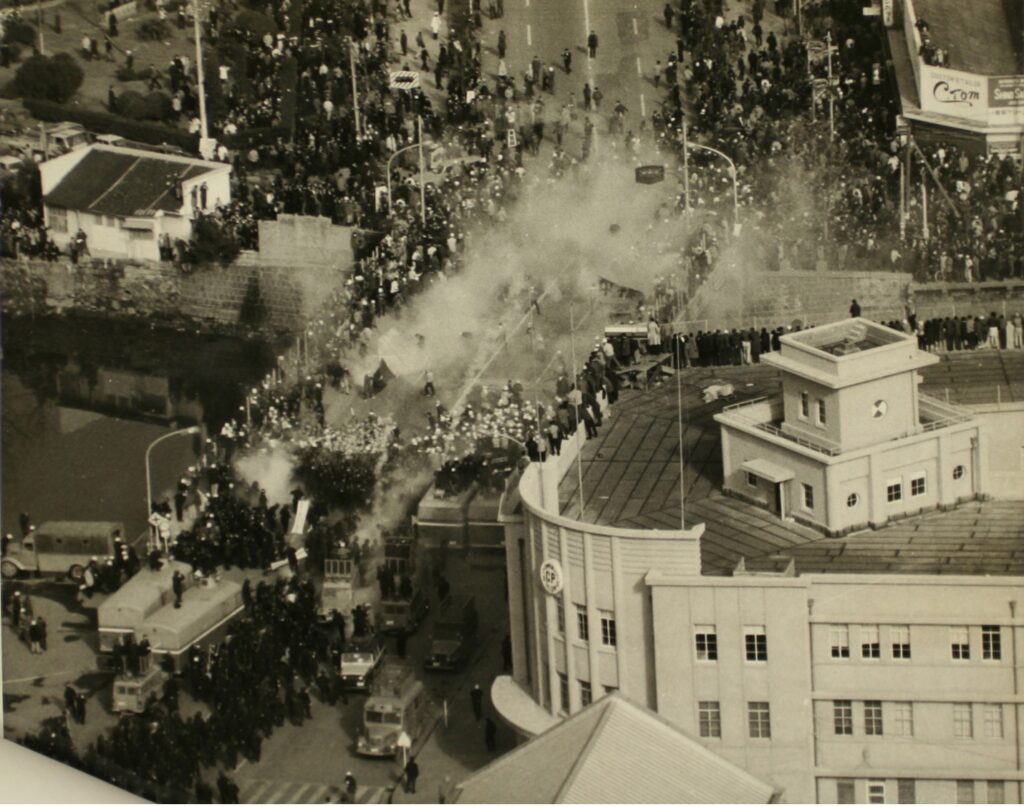
Despite (or perhaps because of) the meticulous planning, it was in fact police overreaction that provoked a national outcry. On January 17, two days before the delayed Enterprise arrived, police exercised their “increased authority” in a spectacular manner.26 As the Embassy reported,
As hundreds of reporters and cameramen looked on, about 375 plastic-helmeted, stave carrying and rock-throwing Sampa Rengo students charged about four times as many riot policemen at a bridge directly in front of the US naval base… the police responded with their own billyclub charge, supported by tear gas and water cannon. The peak of the clash coincided perfectly with the noon television news and millions of television viewers were permitted to see the full force of the police counteroffensive…
[The American Consulate in Fukuoka] also reported …a curious shift in the Sasebo citizens’ attitudes occurred. “The initial mood of apprehension and annoyance at the invasion of trouble-making students was replaced by sympathy and even grudging admiration”… Judging from the press, similar shifts of attitude seemed to be taking place throughout the country.27
The riot police had in fact effectively enacted a spectacular police riot, beating and gassing not only protesters but also citizen onlookers and members of the press, chasing them onto the grounds of the Sasebo Citizens’ Hospital and beating them with their meter-long truncheons despite their lack of resistance. Citizens reportedly intervened too as police dragged injured students from the hospital, or witnessed other acts of excessive police violence.28 The Mayor himself was reportedly shocked by the results of this “warm welcome” and issued a public apology to gassed hospital patients and injured bystanders; police too were ordered to pay courtesy calls to injured citizens.29
Rather than somehow finalizing a homeopathic treatment of the longstanding “nuclear allergy,” or easing negotiations over Okinawa and over the 1970 renewal of the Security Treaty with the U.S., the visit made the Enterprise an icon for nuclear weapons within an inflamed public discourse. The police violence raised the larger question of why, given the likelihood of confrontations, it was necessary to stage this visit—and pay such a price—for a ship only two weeks out of port.30 In the context of Satō’s vague call for “defense consciousness,” Ambassador Johnson observed, it
raised old fears of resurgent militarism and newer fears of nuclear armament. The Enterprise visit is widely interpreted as U.S. collusion with Sato’s scheming to overcome Japan’s ‘nuclear allergy’ (read nuclear weapons allergy). This becomes related to current speculation about U.S. insistence on nuclear bases on Okinawa is price for reversion and Sato’s willingness to pay that price.31
The Government of Japan “had crawled out on a long limb insisting that there could not repeat not have been nukes on Enterprise because U.S. government did not ask for prior consultations.”32 In the wake of the Enterprise’s visit, some Diet members and even Foreign Minister Miki Takeo went on record explicitly denying the presence of nuclear weapons aboard the Enterprise, causing real concern for the U.S. State Department.33
In Japan, the visit was a political watershed: on the one hand, in the face of popular outrage, police were instructed to shift to a defensive position from their posture of aggressive response. On the other, that aggressive response had inaugurated a debate about the government’s violence against its own citizens in support of war. The consequent combination of self-restraint on the part of the previously activist police and augmented public attention made possible the flourishing of new forms of mass political activism in Japan, particularly through non-sectarian and non-party organizations such as Beheiren and the All-Campus Joint Struggle Committees [Zenkyōtō]: their ranks rapidly swelled through the involvement of “ordinary” people and students without prior political experience.34 A “1968” experience in Japan was thus enabled through the unintended consequences of this nuclear politics, and the contradictions between strategic arrangements and popular sovereignty.35
While Prime Minister Satō’s 1965 declaration that the “postwar era” would not be over until Okinawa was returned echoed and antedated other similar statements asserting an end to “postwar,” it shifted the metric for this recurring declaration from economic recovery to a recompletion of the national territory.36 Nonetheless, the suppressed issues around nuclear politics pointed to something more fundamental than economics or territorial integrity: a “postwar” that marked a democracy shot through with unexamined histories and compromises, and a persisting relation to wars old and ongoing. The notion of a restored national unit likewise willfully obscured the thin lines between Okinawan incorporation and the colonial expansions and wars involved in establishing the nation-state of Japan. That long history had been deeply connected to the Asia-Pacific War, with the Pacific theater conflicts fought between imperial powers largely on colonial and semi-colonial territories, and with the post-WWII warfare that followed the “Japanese interregnum” displacing colonial rule, including in Indochina.37 The repeated demands to “end” that “postwar,” that is, that ceaseless relation to war, amounted to a demand to forget the aporetic legacy and embrace a sanitized recovered memory of its history. Okinawan reversion was held out as promising to restore national sovereignty, but the conditions for those negotiations, like all prior strategic negotiations, demanded a short-circuiting of popular sovereignty by secret compromises with the United States, as well as a truncated understanding of nuclear politics in the one country ever subjected to nuclear attack.
The continued entanglements in America’s ongoing wars—Vietnam, and possibly Korea again (the Pueblo incident in 1968 threatened to ignite a second Korean War)—marked a shared relation to warmaking that fundamentally disregarded public scrutiny in the name of national security. Participation in American wars was likewise underwritten by secrecy and manipulations of the public, and even state violence and propaganda, in defiance of democratic debate. Revelations of obscured histories, outright falsehoods and illegal government actions in the wake of the Vietnam War and contemporaneous protests would occasion myriad attempts in the United States to reign in the out of control national security state, from the War Powers Resolution of November 7, 1973 to multiple congressional committee hearings, including the creation of the Church and Pike Committees, and subsequently the establishment of the House and Senate Intelligence Committees.38 In Japan, disclosures confirming the long-rumored CIA station and its role in facilitating and supporting the ruling Liberal Democratic Party, actions and propaganda against the left, and of the secret agreements regarding transit and storage of nuclear weapons, would be years in coming.39
The conflict at Sasebo in January of 1968 arose from the attempt by the U.S. and Japanese governments to facilitate nuclear involvements in regional warfare, to desensitize perceptions and obscure historical recollections over the atomic logics linking the two states together at a time in which ongoing conflicts, sustained by bad reasoning and misrepresentations, threatened further escalations and conflagrations. The police violence brought to bear upon the protests instead underlined for many the ways in which their government was committed to collusion and participation in warfare. If it led the way for a “1968” in Japan, its legacy also points to the link between official secrecy, the sidelining of popular sovereignty, and the likelihood of military misadventure—and even of a breaking of the nuclear taboo. While voices across the political spectrum have blamed some version of 1968 for our contemporary woes—from Pope Emeritus Benedict XVI to Slavoj Zizek—the actuality of that global moment was grounded in solidarity, in improbable recognitions across ostensibly incommensurate local scenes of struggle, equating all of the myriad forms of domination against the singularity of demands for liberation, equality, and voice.40 The present moment, with the spread of rightist governments, jingoistic, bigoted scapegoating rhetorics, and extralegal state violence, with oligarchs discussing the human race as disposable “biological bootloaders” while talking about “Navigating World War Three” and “Bring Back Nuclear,” all point to a moment in which humanity’s fate is again at stake.41 Who will decide our destiny this time?
William Marotti is Professor in the Department of History at UCLA.

Further Reading (in English):
For those interested in a deeper dive into some of the topics considered above, please consider the following.
The literature on the atomic bombings is massive; here are just a few selections in English: On Hiroshima’s expansion to global status and the making of “Hiroshima” memories, see Ran Zwigenberg, Hiroshima: The Origins of Global Memory Culture (Cambridge, United Kingdom: Cambridge University Press, 2014), Lisa Yoneyama, Hiroshima traces: time, space, and the dialectics of memory (Berkeley: University of California Press, 1999), and John Whittier Treat, Writing Ground Zero: Japanese Literature and the Atomic Bomb (Chicago: University of Chicago Press, 1995). On the “postmemory” generations in relation to official memoration, see Akiko Takenaka, Yasukuni Shrine: history, memory, and Japan’s unending postwar (Honolulu: University of Hawaiʿi Press, 2017). On the relative occlusion of Nagasaki and its specifics see Chad Diehl, Resurrecting Nagasaki: Reconstruction and the Formation of Atomic Narratives (Ithaca, New York: Cornell University Press, 2018). A monument commemorating the thousands of Korean victims of the atomic bombing was finally moved within the Hiroshima Peace Park in 1999 (see Monument in Memory of the Korean Victims of the A-bomb, accessed August 12, 2025). While twelve American POWs were killed in Hiroshima, some three thousand American citizens of Japanese descent, largely children of 1st generation issei who could not naturalize, also became victims: see Thousands of Japanese Americans Were in Hiroshima and Nagasaki in 1945. The US Government Still Won’t Recognize Them. – Densho: Japanese American Incarceration and Japanese Internment, accessed August 12, 2025.
Historian Eiji Takemae notes that the nascent peace movement was seen as “communist inspired,” rather like most forms of dissent during the late Occupation and its Red Purges. See Eiji Takemae, The Allied Occupation of Japan, translated and adapted by Robert Ricketts and Sebastian Swann (New York: Continuum, 2003), 506. On public discussions and state surveillance of the Maruki’s work see Yoshida Yoshie, “With the Hiroshima Panels on My Back,” trans. Mabuchi Kanako, National Center for Art Research, Japan, posted July 9, 2024, https://artplatform.go.jp/resources/readings/R202306. The Hiroshima Panels themselves are featured on the Maruki Gallery’s online page, The Hiroshima Panels | Maruki Gallery For The Hiroshima Panels.
Covert involvements involved manifold CIA payoffs supporting (and indeed helping to create) the Liberal Democratic Party which has dominated Japanese politics for decades. See JPRI Working Paper No. 11: July 1995 Chalmers Johnson, “The 1955 System and the American Connection: A Bibliographic Introduction”; Norbert A. Schlei, “Japan’s “M-Fund” Memorandum, January 7, 1991,” and Michael Schaller, “America’s Favorite War Criminal: Kishi Nobusuke and the Transformation of U.S. Japan Relations,” Working-Paper-11.pdf; Tessa Morris-Suzuki, “Democracy’s Porous Borders: Espionage, Smuggling and the Making of Japan’s Transwar Regime (Part I),” Japan Focus 12 (40), 2014. https://doi.org/10.1017/S1557466014028009.
Foreign Minister (and Liberal Democratic Party President) Kōno Yōhei made a direct request to Ambassador Walter Mondale in 1995 that the US not release documents detailing CIA funding for the LDP in its formative years. The Ambassador, Embassy, and CIA station joined to urge suppression of the existence of the CIA station entirely. Embassy to Director, CIA, Telegram Tokyo 24344, “Eyes Only – For C/EA/J – Official Acknowledgement of Tokyo Station,” March 26, 1996, 2, Secret, Eyes Only. National Archives, John F. Kennedy Assassination Records, 2025 Release, Doc ID: 104-10326-10050. The Foreign Relations series would retrospectively acknowledge “in the 1958-1968 decade, the U.S. Government approved four covert programs to try to influence the direction of Japanese political life” in 2006. Foreign Relations of the United States, 1964–1968, Volume XXIX, Part 2, Japan, ed. Karen L. Gatz (Washington: Government Printing Office, 2006), Editorial Note 1. Available online: https://history.state.gov/historicaldocuments/frus1964-68v29p2/d1. The debates over those disclosures are elaborated in William B. McAllister, Joshua Botts, Peter Cozzens, and Aaron W. Marrs, Toward “Thorough, Accurate, and Reliable”: A History of the Foreign Relations of the United States Series (Washington: Government Printing Office, 2015), chapter 12. Available online: https://history.state.gov/historicaldocuments/frus-history/chapter-12.
The revision and adoption of the 1951 Security Treaty into the Treaty of Mutual Cooperation and Security between the United States and Japan occasioned huge protests throughout Japan between late 1959 and the spring of 1960. See Wesley Sasaki-Uemura, Organizing the Spontaneous: Citizen Protest in Postwar Japan (Honolulu, 2001); George Packard III, Protest in Tokyo: The Security Treaty Crisis of 1960 (Princeton, N.J., 1966); Marotti, Money, Trains, and Guillotines; Nick Kapur, Japan at the Crossroads (Cambridge: Harvard University Press, 2018).
On the crucial role of a militarized Okinawa in the production of the mainland economic boom in the 1950s and 1960s, see Jon Mitchell, Why Are We in Okinawa?: A History of Violence (London: Bloomsbury Academic, 2026). As Christopher Nelson observes, the enduring connections to war in the supposed “postwar” led photographer Higa Toyomitsu to call 2010 “year sixty-five of the Battle of Okinawa”; novelist and critic Medoruma Shun refers to the present as “year zero of the postwar,” in Nelson’s words “an unending duration of war, a peace yet to begin.” Christopher T. Nelson, When the Bones Speak: The Living, the Dead, and the Sacrifice of Contemporary Okinawa (Durham, NC: Duke University Press, 2025). https://doi.org/10.1215/9781478060970
Departing Sasebo, the USS Enterprise was caught up with the seizure of the USS Pueblo, a SIGINT ship gathering intelligence off the coast of North Korea. On January 23, 1968, North Korean vessels fired upon and captured the ship and its crew, sparking an incident that raised fears of a second Korean War. The Enterprise, then en route to the Gulf of Tonkin, was rerouted to a position in the Sea of Japan. This fear is explicitly discussed in Airgram A-1098, 15 (see above), even before the Pueblo incident had been reported. The incident had followed close upon the “Blue House” raid of January 21, in which a North Korean team had attempted to assassinate South Korean President Park Chung Hee. The attack was to press South Korea to withdraw its troops participating in the Vietnam War. See Steven Lee, “The Korean Armistice and the End of Peace: The US-UN Coalition and the Dynamics of War-Making in Korea, 1953-76,” Journal of Korean Studies 18 (2): 196-7. The Enterprise finally reached Yankee Station on February 21, three weeks after the start of the Tet Offensive, and commenced attacks on North Vietnam two days later. USS ENTERPRISE (CVAN-65) NARRATIVE COMMAND HISTORY 1968, unpaginated, available at: https://www.history.navy.mil/content/dam/nhhc/research/archives/command-operation-reports/ship-command-operation-reports/e/enterprise-cvn-65-viii/pdf/1968.pdf
On COINTELPRO and other covert abuses of power in the United States: the House Select Committee and House Permanent Select Committee on Intelligence and the Senate Select Committee on Intelligence were both created after a burglary of an FBI field office revealed COINTELPRO and massive, illegal surveillance and counterinsurgency acts by the FBI, CIA, military and other security entities. Daniel Patrick Moynihan notes that the 1997 report from the Commission on Protecting and Reducing Government Secrecy cited Max Weber’s discussion of secrecy and bureaucracy at length: the invention of “official secrets” by bureaucracy, the hiding of its knowledge and action, and its struggle against parliamentary inquiry—and hopes for a “poorly informed and hence powerless parliament.” Daniel Patrick Moynihan, Secrecy: the American experience (New Haven: Yale University Press, 1998), 143.
On Okinawan reversion and nuclear weapons, and the Japanese government’s posture: Norris, Arkin and Burr describe Okinawa as “chock-a-block full of nuclear weapons of all types until 1972.” Norris, R. S., Arkin, W. M., & Burr, W., “Where They Were,” Bulletin of the Atomic Scientists, 55(6), 1999: 79. https://doi.org/10.2968/055006011. Bombs with removable capsules were helpful for politically sensitive allies, including Japan but also France. Ibid, 29. The National Intelligence Estimate of February 17, 1969 would anticipate that Satō “will feel compelled to press hard for the exclusion from Okinawa of the nuclear weapons which virtually all Japanese believe are stored there.“ Document 3. National Intelligence Estimate NIE 41–69, Washington, February 17, 1969, Foreign Relations of the United States, 1969-1976, Volume XIX, Part 2, Japan, 1969-1972 (U.S. Department of State: 2022), https://history.state.gov/historicaldocuments/frus1969-76v19p2, emphasis mine. In December of 1967 Prime Minister Satō was pressed on the intertwined issues of defense and nuclear weapons in relation to Okinawa; he attempted to shift the discourse from a debate about defense to that of “security,” asserting that protection under the U.S.-Japan Security Treaty was compatible with calling for an abolition of nuclear arms, with the Peace Constitution, and with Japan’s averred three nuclear principles—neither possessing nor manufacturing, and not introducing, nuclear weapons into Japan. 57th Diet, House of Representatives, Budget Committee, No. 2, December 11, 1967, 022,https://kokkai.ndl.go.jp/txt/105705261X00219671211/22.
As I wrote elsewhere, “These [three] high-minded principles, which were part of the reason why Satō was chosen to share the Nobel Peace Prize in 1974, were actually an exercise in dissimulation, and perhaps willful misunderstanding, that even today is incompletely detailed within the declassified archival record. By way of secret agreements to the Security Treaty in 1960, Japan explicitly permitted such transits… Satō’s three principles were in effect a doctrine of implausible deniability, sufficing nonetheless to deflect direct accusations of violation from the arrival of any particular ship—even a fully provisioned aircraft carrier heading for a combat station in proximity to Vietnam.” Marotti, “Japan 1968,” 112-13. On the nuclear weapons stored in the Bonin (Ogasawara) Islands—also part of these negotiations—see the National Security Archive “Companion Page to the Bulletin of the Atomic Scientists January /February 2000 Issue,” U.S. Nuclear Weapons on Chichi Jima and Iwo Jima, accessed August 15, 2025. The islands were returned in 1968 with a secret provision that the U.S. could store nuclear weapons there in the event of an emergency.
Also in 1974, in October, Mayor Tsuji of Sasebo would join Tokyo Governor Ryokichi Minobe and Yokohama Mayor Ichiro Asukata in demanding the closure of Japan’s ports to US warships until the U.S. explicitly gives assurances that no nuclear weapons were being brought into Japan. See chronology, Japan and the United States: Diplomatic, Security, and Economic Relations, Part I, 1960-1976 | National Security Archive (accessed August 15, 2025).
- D. G. Kimball, “Trump’s Nuclear Test Rhetoric and Reality,” Arms control today: a publication of the Arms Control Association, 55 no.10 (2025), 3; Erin D. Dumbacher, “The Nonproliferation Chilling Effect U.S. Strikes on Iran Nuclear Sites Could Cause,” Council on Foreign Relations, June 27, 2025, https://www.cfr.org/articles/nonproliferation-chilling-effect-us-strikes-iran-nuclear-sites-could-cause, accessed May 24, 2026. Such concerns followed the transformations in the 2018 Nuclear Posture Review’s reversal of the 2010 stance in its erosion of the nuclear use threshold; see Seyom Brown, “The Trump Administration’s Nuclear Posture Review (NPR): In Historical Perspective,” Journal for Peace and Nuclear Disarmament, 1(2), 268–280. https://doi.org/10.1080/25751654.2018.1494092. Jibes about Pearl Harbor to Prime Minister Sanae Takaichi and references to an “Islamic Republic of Japan” have hardly inspired confidence.
- As the last of the survivors pass away, local initiatives have sought to navigate the loss of their living testimonies. A project training “legacy successors” to offer their direct testimony is segueing into “family member legacy successors” who pass on such stories secondhand. A more troubling experiment by NHK reenacting the experience to children using VR seems to substitute new traumas for fading memory. NHK World-Japan, https://youtu.be/sRH593nq2O4?si=lTM2jZTChRkHOUUw, accessed August 6, 2025. On further considerations of such “postmemory” generations in relation to official memoration, see Akiko Takenaka, Yasukuni Shrine: history, memory, and Japan’s unending postwar (Honolulu: University of Hawaiʿi Press, 2017). The literature on the bombings is massive. See “Further Reading” below.
- “Nuclear Nightmares Are Back,” The Economist (August 6, 2025). Accessed online August 10, 2025. https://www.economist.com/asia/2025/08/06/nuclear-nightmares-are-back
- Covert involvements involved manifold CIA payoffs supporting (and indeed helping to create) the Liberal Democratic Party which has dominated Japanese politics for decades. See “Further Reading” below.
- Historian Eiji Takemae notes that the nascent peace movement was seen as “communist inspired,” rather like most forms of dissent during the late Occupation and its Red Purges. Eiji Takemae, The Allied Occupation of Japan, translated and adapted by Robert Ricketts and Sebastian Swann (New York: Continuum, 2003), 506. Yoshida Yoshie, "With the Hiroshima Panels on My Back," trans. Mabuchi Kanako, National Center for Art Research, Japan, posted July 9, 2024, https://artplatform.go.jp/resources/readings/R202306. The Hiroshima Panels themselves are featured on the Maruki Gallery’s online page, The Hiroshima Panels | Maruki Gallery For The Hiroshima Panels.
- Michael Schaller, The American Occupation of Japan: The Origins of the Cold War in Asia (New York: Oxford University Press, 1985), 46. The former Imperial Japanese colony of Korea received many of the staff trained in anticipation of direct military governance.
- On the preservation of imperial authority in the postwar constitution, see William A. Marotti, Money, Trains, and Guillotines: Art and Revolution in 1960s Japan (Durham, NC: Duke University Press, 2013), chapter two.
- This treaty, signed in 1951 with ratifications exchanged on the day of its commencement, April 28, 1952, was titled Security Treaty between the United States of America and Japan. The revision and adoption of this treaty into the Treaty of Mutual Cooperation and Security between the United States and Japan occasioned huge protests throughout Japan between late 1959 and the spring of 1960. See “Further Reading” below.
- The letters are cataloged online by the City of Hiroshima at www.city.hiroshima.lg.jp/english/peace/1029856/1029857/index.html (accessed August 6, 2025); the City also lists the Peace Declarations: www.city.hiroshima.lg.jp/english/peace/1029846/1029847/1029855/index.html.
- Michael Schaller estimates the Korean War brought over $3 billion in defense expenditures to Japan; direct and indirect sales during the Vietnam War from 1965 to 1972 amounted to $7 billion. Michael Schaller, Altered States: The United States and Japan since the Occupation (New York: Oxford University Press, 1997), 48-9; 198. On the tacit domestic tradeoff of high growth for political options—an eminently political decision with depoliticizing effects—see Marotti, Money, Trains, and Guillotines, 138-9.
- Jon Mitchell, “Vietnam: Okinawa’s Forgotten War,” The Asia-Pacific Journal/ Japan Focus Volume 13 | Issue 16 | Number 1 | Article ID 4308 | Apr 20, 2015): 2.; William Marotti, “Japan 1968: The Performance of Violence and the Theater of Protest.” The American Historical Review 114.1 (February 2009): 108 fn.39. https://doi.org/10.1086/ahr.114.1.97. As Christopher Nelson observes, such enduring connections to war in the supposed “postwar” led photographer Higa Toyomitsu to call 2010 “year sixty-five of the Battle of Okinawa”; novelist and critic Medoruma Shun refers to the present as “year zero of the postwar,” in Nelson’s words “an unending duration of war, a peace yet to begin.” Christopher T. Nelson, When the Bones Speak: The Living, the Dead, and the Sacrifice of Contemporary Okinawa (Durham, NC: Duke University Press, 2025), 7. https://doi.org/10.1215/9781478060970
- On the manifold strategic technology transfers, including transistors and television, see Simon Partner, Assembled in Japan: Electrical Goods and the Making of the Japanese Consumer (Berkeley: University of California Press, 1999). On the crucial role of a militarized Okinawa in the production of the mainland economic boom, see Jon Mitchell, Why Are We in Okinawa?: A History of Violence (London: Bloomsbury Academic, 2026), 107-8.
- See Bruce Cumings, “Japan’s Position in the World System,” in Andrew Gordon, ed., Postwar Japan As History. (Berkeley: University of California Press, 1993), 37-41.
- The expectation of “intense agitation in Japan, probably leading to a restriction on US use of Japanese facilities and possibly to denunciation of the US-Japan defense treaty” headed the list of consequences anticipated by the CIA were the U.S. to use nuclear weapons in Vietnam. Central Intelligence Agency, Office of National Estimates, Memorandum for the Director: Use of Nuclear Weapons in the Vietnam War,” March 10, 1966, 1, Top Secret.
- Action Memorandum, President’s Question about Visit of Nuclear Carrier Enterprise to Sasebo, Japan, Deputy Assistant Secretary of State for Politico-Military Affairs Philip J. Farley and Deputy Assistant Secretary of State for Far Eastern Affairs Samuel D. Berger to Undersecretary of State Nicholas deB. Katzenbach, January 22, 1968, 1-2, Secret, Digital National Security Archive, doc. JU00877.
- Fintan Hoey, Satō, America and the Cold War: U.S.-Japanese Relations, 1964-1972 (London: Palgrave MacMillan, 2015), 18. Hoey argues that “with this speech and the visit as a whole, Satō placed Okinawa reversion at the center of political life in Japan and US-Japanese relations for the duration of his term in office.” Idem.
- The reversion negotiations are discussed at length and with the benefit of Japanese and U.S. declassified documents in Hoey, Ibid. In the month before the trip, there were frequent press reports of the various preparatory discussions and meetings between Prime Minister Satō, Foreign Minister Miki, and Japanese Ambassador to the United States Shimoda Takezō on negotiations over the reversion of both Okinawa and the Bonin (Ogasawara) Islands (the latter also including bases with undisclosed nuclear stockpiles).
- This was the second “Haneda Incident” of 1967, following a similar forceful protest in September seeking to stop Satō from a visit to Saigon and a tour of Southeast Asia. See Marotti, “Japan 1968,” on the singular significance of these protests and their associated politics of violence.
- On the reversion of Okinawa and nuclear arrangements, see “Further Reading” below.
- Telegram 4763, “Enterprise Visit to Sasebo,” January 17, 1968, 3, Secret, Digital National Security Archive, doc. JU00876, 5.
- Although visits to Yokosuka by SSNs were not yet completely casual affairs, the U.S. embassy had reported declining participation and media interest in rallies during the three prior SSN visits (the USS Snook in May–June 1966, the USS Seadragon in September 1966, and the USS Sculpin in March 1967), and coupled with “little, if any, nation-wide interest” in the events, had thus anticipated “no political problems in connection with visit.” Telegram 10948, Ambassador Johnson to Department of State, July 13, 1967, CF 1967–1969, Def 7 Japan-US, Secret, in Confidential U.S. State Department Central Files: Japan 1967–1969 [hereafter Confidential Files: Japan], reel3, 0005; the report of “little, if any, nation-wide interest” addressed the March visit of the Sculpin, a Skipjack class submarine like the USS Scorpion, which, when lost in May 1968, sank with two nuclear torpedoes in its armament. Telegram 5790, USNIS to Secretary of State, March 6, 1967, CF 1967–1969, Def 7 Japan-US, 2, Confidential, in Confidential Files: Japan, reel 3, 0097–0098. The June 1967 visit of the nuclear submarine USS Barbto Yokosuka Naval Base had produced the smallest such protest to date. According to an embassy report, “Opposition was able to mount only two significant demonstrations—2000 [participants] June 20 and approximately 5000 on June 25. Both demos orderly and with significant decline in student participation . . . Although we have not reached point where Yokosuka visits can be considered ‘routine’ emb[assy] believes significant progress was made in lessening public concern in SSN’s.” Telegram 025536, Ambassador Johnson to Department of State, June 29, 1967, CF 1967–1969, Def 7 Japan-US, Confidential, in Confidential Files: Japan, reel 3, 0008.
- The Mayor here refers to “Zengakuren,” an abbreviation for Zen-nihon gakusei jichikai sorengo. It is a federation of the self-government associations [jichikai] at the various universities, and provides resources therefore controlled by the groups that have succeeded on their campuses in gaining control over their local jichikai. At this time it was split by multiple factions, and a major division between the Minsei group (short for Nihon minshūseinen dōmei, the Japan Democratic Youth League) tied to the Japan Communist Party (JCP), and the more activist anti-JCP groups which had taken the lead in recent confrontations.
- Telegram 4763, “Enterprise Visit to Sasebo,” 2-3. An earlier report put the total number at 5800. Telegram 4658, “NPSS Visit Sasebo,” January 12, 1968, National Archives and Records Administration, RG 59, Records of the Department of State, Central File 1967–1969 [hereafter CF 1967-1969], Def 7 Japan-US, 3, Confidential.
- Telegram 4763, “Enterprise Visit to Sasebo,” 4.
- Details of movements, plans for action, the numbers of activists by university, and of key leaders were communicated to navy investigators by the Japanese government, as reported in Telegram 020939Z, U.S. Naval Investigative Service Sasebo, January 1, 1968, CF 1967–1969, Def 7 Japan-US, 2–3, Confidential. Police and the U.S. Naval Investigative Service (USNIS) also monitored the movements of alleged Chinese and Soviet agents to the area, without finding any direct connections to protest. Oda Makoto and Yoshikawa Yuichi of Beheiren and Iwanami Publishing’s Yamaguchi Kazunobu (connected to reports on the Intrepid desertions) are among those named specifically in surveillance of activists arriving in Sasebo. According to USNIS, two police sergeants from the Tokyo Metropolitan Police Board “were assigned to Sasebo specifically to work on Beheiren and related defector activities”; USNIS maintained close contact with them. USNIS took particular note of suspected Beheiren members’ participation in activist student and JCP events, and their connections with journalists. Their pamphlets, which encouraged all levels of resistance from letter-writing and token walkouts to desertion and filing for conscientious objector status, were read closely. Telegram 191744Z, USNIS Sasebo to USNIS Japan, January 19, 1968, CF 1967–1969, Def 7 Japan-US, 3, Secret, Noforn [No Release to Foreign Nationals]; Telegrams 201523Z and 201552Z, USNIS Sasebo to USNIS Japan, “Defector Siterep Five,” CF 1967–1969, Def 7 Japan-US, 1–5, Secret, Noforn. During the visit, Maritime Safety Bureau vessels had been assiduous in keeping the group’s rented water taxi far enough to prevent their desertion-soliciting placards from being readable from the ship’s berth in the bay. The embassy would also issue secret instructions to Rear Admiral Horace Epes, Jr., and Captain Kent Lee of the Enterprise in advance of their press conference; the Ambassador himself flew to the Enterprise just prior to its arrival to elaborate on those instructions. See Marotti, “Japan 1968,” 113.
- Airgram A-1098, “The Enterprise Visit,” February 23, 1968, 8, Secret.
- Airgram A-1098, “The Enterprise Visit,” 6. Ambassador Johnson noted that major protests in Tokyo, Kobe, Osaka, and Nagoya, as well as the majority of protests in Sasebo that did not feature direct confrontations, were all overshadowed in news reports of these scenes. Airgram A-1098, “The Enterprise Visit,” 8. Sanpa (here “Sampa Rengo”) indicated three anti-JCP factions acting in concert, nominally; in 1967 these were Chūkaku (the Nucleus Faction, part of the Marxist Student League), Shagakudō (the Socialist Student League), and Shaseidō (the Socialist Youth League; originally associated with the Japan Socialist Party, the breakaway, radical Kaihō faction was the one represented in Sanpa).
- For details see Marotti, “Japan 1968,” 119-25. Police also used water hoses spiked with eye irritant and concussion grenades. On the notably different dynamics in Hiroshima in the 1960s, especially involving student activist confrontations with police, see Zwigenberg, Hiroshima, chapter six; also available in Ran Zwigenberg, “A Sacred Ground for Peace: Violence, Tourism and Sanctification in Hiroshima 1960—1970.” In War and Peace (London: Anthem Press, 2013), 121–44. https://doi.org/10.7135/9780857283092.007.
- Years later in October 1974, Mayor Tsuji would join Tokyo Governor Ryokichi Minobe and Yokohama Mayor Ichiro Asukata in demanding the closure of Japan's ports to US warships until the U.S. explicitly gives assurances that no nuclear weapons were being brought into Japan. See chronology, Japan and the United States: Diplomatic, Security, and Economic Relations, Part I, 1960-1976 | National Security Archive (accessed August 15, 2025).
- Telegram 5586, “Aftermath of Enterprise Visit,” February 13, 1968, 3, Secret, Exdis. It was another ship based in Sasebo, though, that soon added to the possibility of further wars directly involving Japan: the the USS Pueblo, a SIGINT ship seized on January 23 by North Korean vessels while gathering intelligence off the coast of North Korea. See “Further Reading” below.
- Ibid., 2-3.
- Memorandum for the President: Visits of U.S. Nuclear Ships to Japan, Special Assistant for National Security Affairs Walt Rostow, January 26, 1968, Secret; No Foreign Dissem; Limdis, CF 1967–69, DEF 7 JAPAN–US, 1. “The reputation of the Enterprise as the main element of Seventh Fleet strength lent credibility to charges that there were nuclear weapons aboard.” Airgram A-1098, “The Enterprise Visit,” 2. The Enterprise likely had around 100 nuclear weapons on board at the time. Declassified: US Nuclear Weapons At Sea - Federation of American Scientists, February 3, 2016 (accessed August 11, 2025). In the entire Pacific, there were 1709 nuclear weapons aboard ships in 1968. Norris, R. S., & Kristensen, H. M. (2016). Declassified: US nuclear weapons at sea during the Cold War. Bulletin of the Atomic Scientists, 72(1), 59. https://doi.org/10.1080/00963402.2016.1124664.
- For a detailed account of this watershed, see Marotti, “Japan 1968”; also William Marotti, “The Performance of Police and the Theatre of Protest,” Journal of Dramatic Theory and Criticism 35, no. 2 (Spring 2021), 117-23. DOI: 10.1353/dtc.2021.0009.
- I expand on this thesis, and on the nature of this transformation, in my book in progress, ”The Art of Revolution: Politics and Aesthetic Dissent in Japan’s 1968.”
- On Satō’s speech on August 19, 1965, in Naha, see Hoey, 18. An earlier administration had declared in 1956 that economic recovery meant that the “postwar” had ended. The conclusion to the 1956 White Paper marked this on the basis that real per capita GDP had exceeded the 1940 level, and that a drive to recovery was now transitioning to economic expansion. Keizaikikakuchō, Keizaihakusho 1956 (Ōkurasho printing bureau, 1956). Available online: https://www5.cao.go.jp/keizai3/keizaiwp/wp-je56/wp-je56-010501.html.
- The term, Asia-Pacific War, specifically addresses this aspect of WWII; the conflict is also named as the Fifteen Years War when dated from the incursion into northeast China in the wake of the Manchurian Incident (launched after the pretext of a staged terrorist attack on the South Manchurian Railway in Mukden) in 1931 and the conquest of the territory renamed Manchukou in 1932.
- The House Select Committee and House Permanent Select Committee on Intelligence and the Senate Select Committee on Intelligence were both created after a burglary of an FBI field office revealed COINTELPRO and massive, illegal surveillance and counterinsurgency acts by the FBI, CIA, military and other security entities. See “Further Reading” below.
- Foreign Minister (and Liberal Democratic Party President) Kōno Yōhei made a direct request to Ambassador Walter Mondale in 1995 that the US not release documents detailing CIA funding for the LDP in its formative years. See “Further Reading.”
- As I have argued elsewhere, the Vietnam War served as a flexible reference point across diverse political scenes, linking the global and the local, from anti-colonial struggles to the “convergence of diverse scenes of politics upon the importance of examining one’s own daily life for its connection to forms of domination.” See Marotti, “When Art Grabs You: Grasping Art and Politics in the Global 1960s with Yoshio Nakajima,” Art and Street Politics in the Global 1960s: Nakajima Yoshio and the Global Avant-Garde, William Marotti, ed., Routledge Global 1960s and 1970s (London: Routledge, 2023), 148-151. https://doi.org/10.4324/9781003149149.
- On humanity as “biological boot loaders” for a supersessive digital intelligence, see Ricki Harris, “Elon Musk: Humanity Is a Kind of 'Biological Boot Loader' for AI,” Wired (September 1, 2019). Accessed July 9, 2026: https://www.wired.com/story/elon-musk-humanity-biological-boot-loader-ai/ On the cited topics, see Dell Cameron and Yulia Almazova, “Leak Exposes Members of Peter Thiel’s Secretive ‘Dialog’ Society,” Wired (June 16, 2026). Accessed July 9, 2026: https://www.wired.com/story/leak-exposes-members-of-peter-thiels-secretive-dialog-society/.
One Reply to “William Marotti, Sovereignty and Nuclear Politics in 1968: the Visit of the USS Enterprise to Sasebo, Nagasaki Prefecture”
This is so important. I read William Marotti’s essay and the bibliographic materials and thought, my entire life has been marked by this historical reality. Thank you so much for this stubborn reminder. The detailed history of what it takes to refuse to forget.