


Since 2010 I have been listening to first and second-generation Korean victims of the atomic bomb and documenting their expressive lives. In November 2026 many of the victims whom I work with will host an International People’s Tribunal on the 1945 US Atomic Bombings, for the purposes of “examin(ing) the legal responsibility of the United States government for the atomic bombings of Hiroshima and Nagasaki in 1945. People’s tribunals, which originate in the 1960s, 1. are important interventions in the global practice of law: they attempt to make human beings, not state or corporate actors, the central focus and the executive authority of law. With the prospect of the International People’s Tribunal on the atomic bombings in view, in this essay I offer some suggestions about how to listen, how to hear as fully as possible the people who are and must remain the central focus and concern of the People’s Tribunal.
In March of 2026, I took part in an Association for Asian Studies conference panel on “People Power: Grassroots Legal Campaigns against Intra- and Inter-state Violence in the Aftermath of WWII and the Cold War,” organized by Lin Li of Kenyon College. The panel concerned two current grassroots legal efforts. The first of these is the current lawsuit in which South Korean women accuse the US military of illegal abuse, confinement, and medical treatment in the sex work network surrounding American military bases in South Korea. The second legal movement we were to discuss was the International People’s Tribunal on the US Atomic Bombings. I prepared my remarks by speaking with one of my key interlocutors, Han Jeongsun, by telephone. Han Jeongsun is one of the main plaintiffs in the People’s Tribunal, a second-generation victim of the atomic bombing of Hiroshima, and head of the Korean Society for Second Generation Atomic Bomb Survivors. I asked her about her reasons for participating in the People’s Tribunal.
“The most important reason is to let people know that we, as victims, exist,” she told me. When the atomic bombs fell on Japan in 1945 there were about 70,000 Koreans in Hiroshima and 30,000 in Nagasaki. Koreans had been recruited from underdeveloped parts of Japanese colonial Korea to do many of the most dangerous jobs involved in the construction of the Japanese empire and its military industrial complex; and the Hiroshima and Nagasaki Koreans had largely been brought to Japan for munitions labor. About half of the Hiroshima and Nagasaki Koreans died in the bombings; the rest and their descendants have lived out their lives with injury, illness, and developmental disabilities arising from the experience of the bombing and the legacy of radiation exposure.
It is convenient for the US to ignore the existence of the Korean victims of the atomic bombs, because they are unquestionably innocent victims who cannot be cast as aggressors. It is convenient for Japan to hush up Korean victims, as it helps consolidate the Japanese monopoly on nuclear victimization, part of the post-war sleight-of-hand by which Japan transformed itself from an aggressor nation to a victimized people (see Yoneyama 1999). Even in South Korea, where the atomic bomb has been enshrined in history as an agent of Korea’s liberation from Japanese colonialism, historical consciousness has been reluctant to acknowledge its Korean victims. All of these forces of forgetting are why Han Jeongsun insisted first and foremost that the US and the international community recognize victims’ existence.
She told me of her hopes that the People’s Tribunal will make that possible. “When we said we were going to the US…there’s an expression you probably know. People told us that it will be like ‘hitting a boulder with an egg.’” They told her it would be useless. “But,” she went on, “I don’t think of it that way. Thinking of the victims, especially the second-generation radiation sufferers, and how they have to leave the world in this terrible pain, it’s awful. That feeling of being ill-used… What we’ve got is not a chicken egg, it’s a quail’s egg. It’s so much smaller. We throw it to express these awful feelings, although it likely won’t break the stone. But we want to leave behind even a trace. And in this way victims might be able to relieve their hearts of their burdens just a little. And we want to ask people to understand the depth of these horrible feelings. We want to shout to demand such understanding. We want people to see our will to strike the stone with our pain. And in this way we want to communicate to Americans that even now there are people suffering as the result of the use of nuclear weapons.”
The atomic bomb, in the global imagination, conjures up images of mushroom clouds and horrible injury and destruction. If you have looked into the matter, you may have read something about it, perhaps starting with John Hersey’s astounding Hiroshima. The global imagination about the atomic bombs is largely silent, which means it is devoid of living people. It has been framed as a historical event, not the living legacy that it is, which continues to harm countless people. One way of acknowledging these people is to listen—to actually listen—to victims. The International People’s Tribunal, a remarkable product of the community of Korean bomb victims’ grassroots activism, is the best opportunity for the international community to do so yet.
In my monograph Quietude: A Musical Anthropology of ‘Korea’s Hiroshima’ (2022), readers encounter and listen to several victims at length, hearing their voices on the book’s website. Theirs are practically inconceivable stories of suffering and endurance, as double victims of the Japanese colonial exploitation of Koreans and the indiscriminate atomic bombing of Asian civilians by the United States. For all their injury and fragility, their voices have a strength that is powerful beyond the words that human voices are often reduced to, in scholarship, in thought, and in legal proceedings.
Han Jeongsun is a second-generation victim of the bomb because her parents were in Hiroshima at the time of the bombing. Her mother was pregnant with her older brother, who died soon after they relocated to Korea at the end of the war. All of her siblings have suffered from the intergenerational transfer of illness and disability that is the legacy of the atomic bombing and its radiation. Her youngest sibling lost all of his teeth as a child. Han Jeongsun herself suffers from avascular necrosis, a degenerative bone disease that has required her to have twelve surgeries for knee replacement. Her son suffers from cerebral palsy and, as she puts it, “lives lying down.”
There is much to be learned from listening to Han Jeongsun’s voice, and her often spoken, sometimes sung narration of her experiences. In my book, I investigate the remarkable ways that she draws on popular cultural resources in her effort of survival and in her activist speech—in official statements, testimonies, and casual talk. Through sung and spoken quotation she weaves songs into tapestry-like narratives of the experiences of second-generation victims of the atomic bomb. In so doing, she connects the experiences of profoundly marginalized and forgotten Korean atomic bomb victims with core metaphors of mainstream popular culture, making profoundly compelling claims to social membership and a plea for recognition.
Han Jeongsun does this work of connection utilizing myriad songs of struggle from the 20th century genre of Korean ballads known as teuroteu, an abbreviated Koreanization of ‘foxtrot.’ ‘Trot’ originates in the Japanese colonial period and is perhaps the genre that most painfully and ambivalently expresses the sorrows of Korean modernity. She borrows the many references to walking as a metaphor for struggle found in Korean popular song in order to relate this core metaphor to her literal experiences of difficulty walking. Yu Jina’s 2009 “Gochu” (Hot Pepper), with its references to the seemingly endless chains of mountain passes that dot the Korean landscape, Shin Yu’s 2008 “Jam janeun gongju” (Sleeping Princess), which invokes the ‘world road’ (sesang-gil) one walks in life, and “Queen of Elegy” Yi Mi-ja’s 1968 “Yeojaui ilsaeng” (Woman’s Life), which refers to the “weary life-road” (godalpeun insaeng-gil), are just some of the references to walking that make appearances in her narratives. Han Jeongsun may sing a verse, or quote a text for support, or slip in a phrase from a song text so subtly that only people deeply familiar with the ‘trot’ genre would even know it was there.
Han Jeongsun’s knack for making these connections and for encapsulating experience in speech are just two aspects of her eloquence, which has assured her central place in the movement. Her narration of the second-generation experience has had subtle and enduring effects on the activism and media coverage surrounding Korean first and second-generation bomb victims. Her poetry of walking as struggle, for instance, surfaces across the activist discourse of the second-generation movement (Pilzer 2022: 170). And all of this eloquent activism has culminated in her central role in the upcoming International People’s Tribunal.
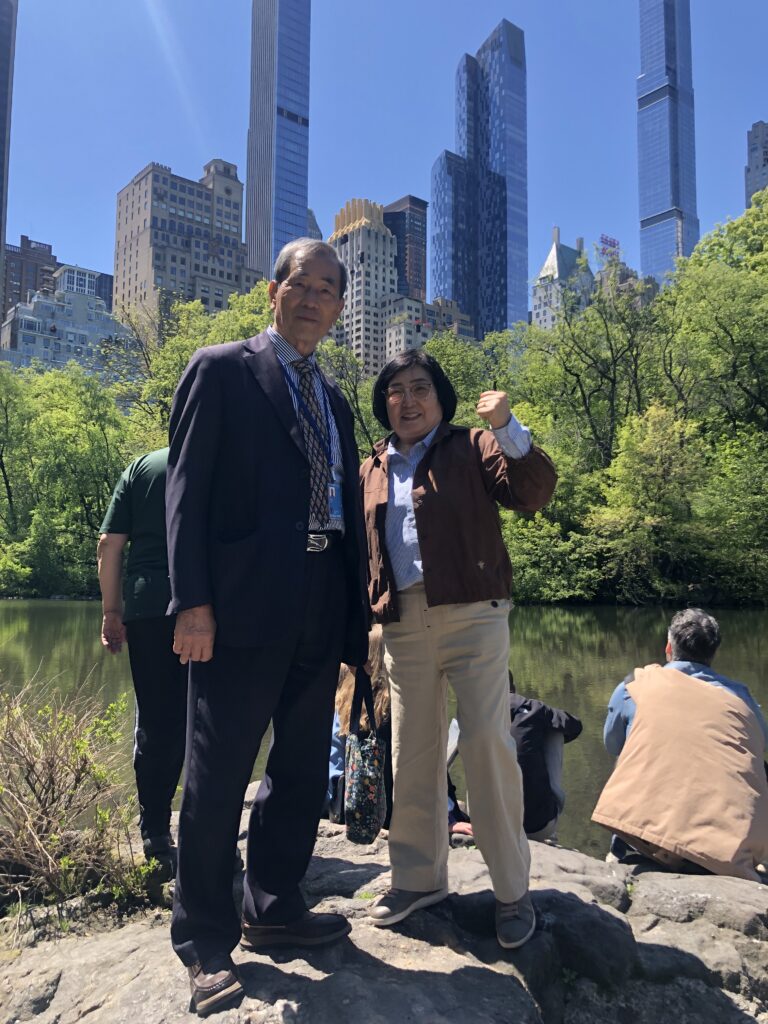
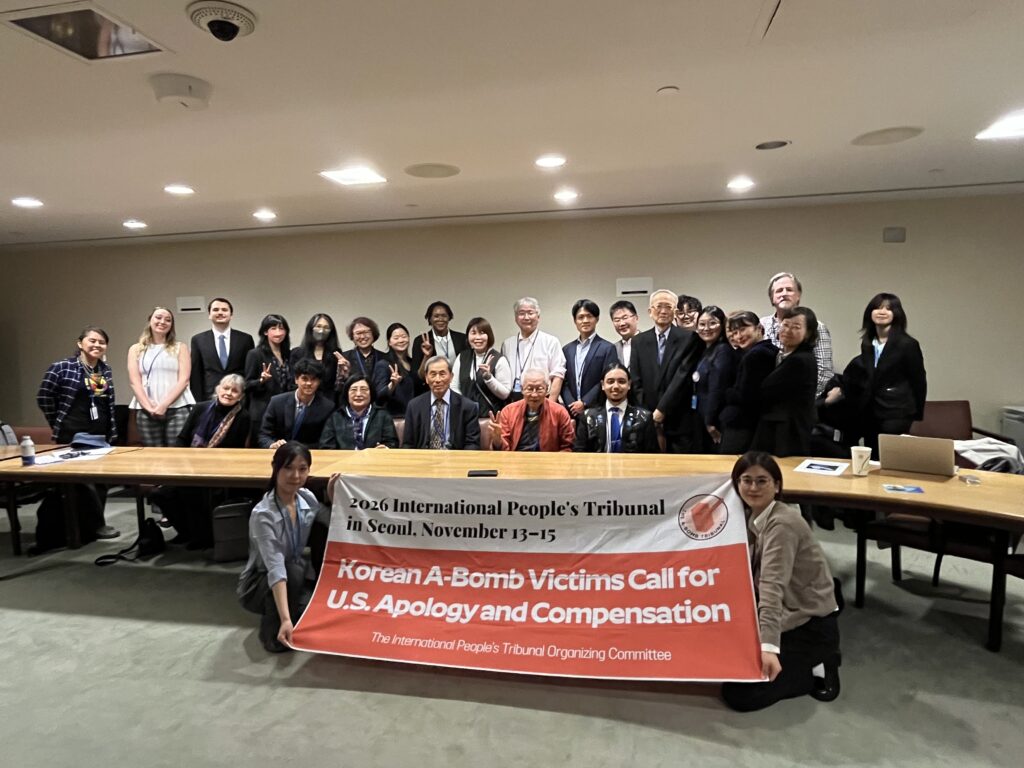
As we concluded our telephone call Han Jeongsun told me that she and Shim Jintae, a first-generation victim of the bombing of Hiroshima and director of the Hapcheon Branch of the Korean Atomic Bomb Victims Association, were planning to visit the US a few months later for a speaking tour, in order to spread the word about the tribunal. So in May 2026 I travelled to the UN to hear her and Shim Jintae speak at a side event held during the 11th Review Conference of the Parties to the Treaty on the Non-Proliferation of Nuclear Weapons. The panel was put on by SPARK, Solidarity for Peace and Reunification of Korea, an activist organization founded in 1994 to fight for a more equable relationship between the US and Korea, and to pursue peace, disarmament, and Korean reunification.
Shim Jintae spoke first. He told us briefly about his childhood in Hiroshima, before giving a long and reasoned indictment of the US for its failure to acknowledge that the atomic bombings were war crimes. “How can there be victims without aggressors?” he asked. “How, if the US refuses to accept responsibility for the 1945 atomic bombings how do we hold accountable any nation that seeks to use nuclear weapons today?”
Han Jeongsun presented next, speaking forcefully and clearly, clearly feeling the gravity of the situation. This was not quite the place for her rich cultural embroidery, but for succinct, unequivocal and articulate expression of the situation of Korean second-generation victims, and of her suffering and anger. She read from a text she had written. She described her family’s suffering due to the bomb, and the onset of her avascular necrosis. She described being unable to walk, and how the floor of her apartment was covered in blood as she used her torn hands to move about. She spoke of her activism on behalf of second-generation victims. She voiced her frustration about the refusal of the United States to offer apology or compensation to the victims of the atomic bombings of Japan. She concluded by expressing her hopes for the International People’s Tribunal.
Han Jeongsun’s speech was filled with the sort of epigrammatic brilliance that has made her so important to the movement. She described how the damage of nuclear radiation passes down mercilessly through the generations. “In mybody, the war rages endlessly,” she said. The translation of this speech on the webpage of the International People’s Tribunal, which records her making the statement at an event in March 2025, omits that last, epigrammatic line,2 perhaps because she added it later. Whatever the reason, there is a richness missing from the written transcript that leads me to suspect that the entextualization of thought and speech here does more than just flatten both into text; its flattening effect extends to the content of expression as well. Han Jeongsun’s speech was originally text, although it was written to be read aloud and listened to. A written transcript of a read speech thus endures two phases of entextualization, such that few traces of the sound and the sounding body remain. And yet the body, as Han Jeongsun has told us, is the locus of victimization.
Listening to victims’ voices allows for hearing that does not erase, in the entextualization of experience, the human bodies that bear the legacy of the bombs. To listen in this way, it is essential to pay attention to what they say and how they say it as if these two aspects of expression were of equal importance. This means that one can listen to half the story without knowing the languages in which victims are speaking. It is also essential to listen beyond official contexts, to encounter the broad range of expressive practices that constitute the expressive ecology of victims as activists and witnesses to experience.
Victims like Han Jeongsun and Shim Jintae imbue their speech with an unimaginable strength. They offer their voices, phrases, statements, and narrative tapestries to listeners, such that they might educate and energize the movement on behalf of justice for the victims and a nuclear-free world. These voices and their messages are things listeners can learn from; but they are also tools we can all use in pursuit of human flourishing.
References Cited:
Hersey, John. 1946. Hiroshima. New York: Alfred A. Knopf.
International People’s Tribunal on 1945 US Atomic Bombings. 2026. “Leaflet: The International People’s Tribunal to hold the US accountable for dropping A-bombs.” Online document, https://abombtribunal.campaignus.me.
Pilzer, Joshua D. 2022. Quietude: A Musical Anthropology of “Korea’s Hiroshima.” New York: Oxford University Press.
Simm, Gabrielle, and Andrew Byrnes. 2013. “International People’s Tribunals in Asia: Political Theatre, Juridical Farce, or Meaningful Intervention?” Asian Journal of International Law 4: 103-24.
Yoneyama, Lisa. 1999. Hiroshima Traces: Time, Space, and the Dialectics of Memory. Berkeley: University of California Press.
Joshua D. Pilzer is Associate Professor of Ethnomusicology in the Faculty of Music, and an affiliate faculty of the Centre for the Study of Korea at the University of Toronto.
- The first people’s tribunal was the Russell Tribunal of 1967, established by British philosopher Bertrand Russell and others to investigate US war crimes in the Vietnam War. Since then, there have been more than eighty, in attempts to “overcome the deficiency in international society that allows gross crimes of state to persist without notice or remedy” (Simm and Byrnes 2013: 103).
- https://abombtribunal.campaignus.me/campaign/?q=YToxOntzOjEyOiJrZXl3b3JkX3R5cGUiO3M6MzoiYWxsIjt9&bmode=view&idx=157305741&t=board, accessed August 24, 2026.