


Masao Adachi, the subject of William Andrews’ book, Pink Auteur, Red Outlaw that is under review here, published a “Statement of Protest” on September 25, 2026 stating that “at no point did I give my consent or approval, nor was I ever provided with a finalized revised manuscript” of the book. The statement, which is available in Japanese and English here, https://x.com/yujidan/status/2103707697434747187 further states that he sent the author and publisher a “Request Letter” and a “Notice” “demanding that material obtained through our relationship of trust not be used” without confirmation. The “Statement of Protest” is Adachi’s objection to the publication and to the publisher’s promotion of the book as being “based on extensive interviews” with him. In response Andrews published a response on October 1, 2026, published here, also in English and Japanese, https://x.com/TokyoStages/status/2105555372388041159 which objects to the facts included in the “Statement of Protest.” He counters that Adachi’s “approval of the manuscript was [never] a condition of his cooperation” and that a completed manuscript was provided to Adachi as a courtesy prior to publication. Williams asserts that the book’s nature as an “independent, unofficial biography” precludes any granting of editorial control to Aachi, and states that Adachi “indicated his respect for freedom of speech and that he would not seek to prevent publication” during their final meeting in July 2026. We include this context as a point of information for the reader.
On behalf of the praxis editors, WM
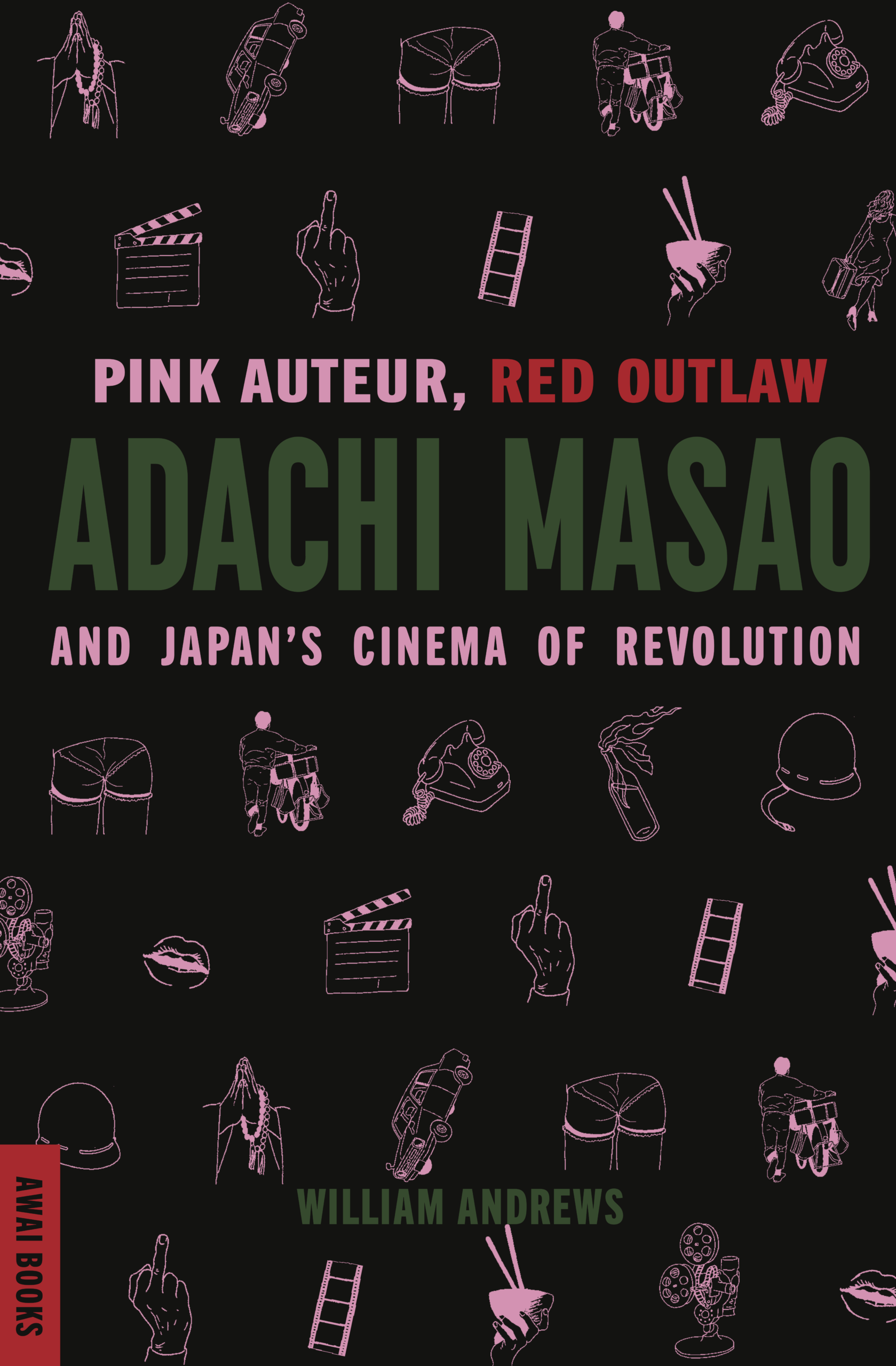
William Andrews, Pink Auteur, Red Outlaw: Adachi Masao and Japan’s Cinema of Revolution (Tokyo and New York: Awai Books, 2026).
On May 7, 1964, a screening of Closed Vagina (1963) at Kyoto’s Gion Kaikan came to an abrupt halt. Half the reels had gone missing. The previous day, Adachi Masao and his collaborators had staged their “Closed Vagina Ritual” in Maruyama Park: Kazakura Shō played a piano with a whip while Akasegawa Genpei set fire to paper and flung it about the stage. Members of the League of Criminals, a left-wing prank collective founded at Tokyo’s Waseda University, had since hidden in the hall overnight and stolen the reels, adding their own unauthorized happening. The audience demanded refunds, riot police gathered outside, and Adachi persuaded the managers to keep the police out. He insisted the theft belonged to the work, as did the audience’s anger. That evening the reels turned up again beneath the artists’ futons. As William Andrews notes, beyond contributing to the evening’s improvisatory spectacle, the theft may have also spared Adachi arrest on obscenity charges (22–23).
Episodes like this make Pink Auteur, Red Outlaw such an absorbing history. Andrews follows Adachi through the people, institutions, and political movements that made his films possible, including collaborators who eventually challenged his authority over them. The stakes changed as Adachi moved from the experimental happenings of the early 1960s toward a cinema conceived as a weapon in revolutionary struggle. Making a film, getting it shown, and arguing over its use became forms of political activity in their own right. What might such activity contribute to the formation of revolutionary political subjects? And what happens when the people enlisted to circulate a film claim the right to decide its direction?
Born in 1939, Adachi entered filmmaking through the Nihon University Film Study Club and Tokyo’s experimental art scene, amid the New Left’s challenge to the established Communist Party and Japan’s postwar order. He worked in the low-budget soft-core “pink” industry with Wakamatsu Kōji, collaborated with Ōshima Nagisa, and helped develop fūkeiron, or landscape theory, which found the power of the state and capital at work in the most unremarkable features of everyday life.
In 1971, Adachi and Wakamatsu traveled to the Middle East, where they worked with Palestinian revolutionaries to make Red Army / PFLP: Declaration of World War (1971), an agitprop film intended to circulate as part of an international revolutionary movement. Returning to the Middle East in 1974 to continue filmmaking and forging political collaborations, he became increasingly involved with the Japanese Red Army (JRA) and remained abroad living underground until his arrest in Lebanon in 1997. Deported to Japan in 2000, Adachi returned to directing with films that revisited the revolutionary struggles of his past while also confronting questions of imprisonment, state violence, and the political uses of art.
Adachi’s long absence from Japan has often been told as the story of a filmmaker who exchanged his camera for a gun. Andrews challenges the simplicity of this account, tracing a persistent Surrealist sensibility, hostility to authority, and commitment to collective solidarity across Adachi’s filmmaking and political life. He proposes judging Adachi by the value of his partnerships and collective commitments (xvii). The resulting biography is conceived as an “ensemble piece,” a history of “Adachi and Co.” in which Adachi’s career takes shape through relationships he could never entirely control (xiv).
Andrews’s earlier Dissenting Japan (2016) surveyed postwar radicalism and counterculture on a broad historical canvas. This book follows one participant through the organizations and movements that gave that history its shape. Interviews with Adachi and his contemporaries sit alongside periodicals, publicity materials, screening flyers, and newspaper reports. From these sources Andrews deftly reconstructs the disagreements and competing ambitions that shaped Adachi’s work, often bringing conflicting accounts of the same events into view.
The book’s fourteen chronological chapters give its many personalities and shifting alliances room to emerge. Andrews writes with an unhurried clarity, particularly when tracing the work behind a film: who financed it, who helped make it, where it traveled, and what disputes followed. This clarity, together with extensive notes, bibliography, filmography, and list of major unproduced screenplays, makes the biography a substantial resource for further research.
Even the question of who made Adachi’s early films proves less straightforward than their credits suggest. Works initially attributed to filmmaking collectives increasingly came to be identified with Adachi alone as screenplays and publicity materials circulated. Their collective ambitions had been “sabotaged by the process of publication,” Andrews writes (62). An individual artistic reputation could thus take shape through the circulation of work made with others, even as those contributors receded from view.
Commercial filmmaking offered Adachi room to experiment, though never on his own terms. Pink films supplied inexpensive attractions to theaters competing with television; producers tolerated formal experiment provided distributors received the sexual content they expected. The art-house circuit also had its own commercial dependencies. The Art Theatre Guild (ATG), a major supporter of independent and experimental cinema, was substantially owned by Tōhō, the studio behind Kurosawa’s films and Godzilla. Andrews does not romanticize the freedoms these arrangements afforded. Adachi could criticize the New Left through pink cinema without escaping the sexism of the genre. In Schoolgirl Guerrillas (1969), for example, five high-school runaways play at guerrilla war in the mountains. Andrews reads the film as an exposure of New Left sexism but stops short of calling it feminist, given its failure to critically examine the sexual mistreatment it depicts.
The question of authorship becomes more difficult with Galaxy (1967). Andrews suggests that Adachi’s refusal to settle on a consistent style becomes, paradoxically, an auteurial statement (61). This is plausible, though it makes auteurism difficult to question when both stylistic consistency and its refusal can establish an authorial signature. Given the collective production arrangements Andrews reconstructs, why should these differences in style be attributed so readily to Adachi? His reading risks reinforcing the attribution of collective work to an individual filmmaker, a process he painstakingly traces through publication’s role in consolidating Adachi’s authorship.
In A.K.A. Serial Killer (1969), Adachi and his collaborators traveled across Japan, retracing the movements of Nagayama Norio, a young migrant worker arrested for four murders. The protagonist himself never appears. Rather than pathologizing Nagayama, the film turns its attention to the world that produced him. The stations, housing blocks, and industrial districts through which Nagayama passed appear unremarkable, their very sameness suggesting how thoroughly the power of the state and capital had come to organize everyday life. Landscape was no longer simply the setting in which events unfolded, but a means of making visible the social conditions that the filmmakers sought to question.
The filmmakers initially had no intention of screening the finished work, dividing its six reels among themselves instead. Making the film, Andrews explains, was already a way to investigate social problems and test what cinema could do. Before it had an audience, A.K.A. Serial Killer had already been a form of collective aesthetic research, a shared exercise in looking at the world.
The relation between collective activity and individual authorship became an explicit point of disagreement. In a roundtable published in the September 1973 final issue of Film Criticism, Ōshima rejected Adachi’s idea of a “cinema of movement,” insisting that films made within political movements remained the work of individual auteurs (154). Adachi’s conception of filmmaking and exhibition as political activity had already faced a practical test in the production and circulation of Red Army / PFLP.
The production of Red Army / PFLP brought these ambitions into direct contact with the demands of a revolutionary organization. The Popular Front for the Liberation of Palestine (PFLP), whose guerrilla activities the filmmakers had traveled to document, permitted filming on condition that they collaborate with Japan’s Red Army Faction (Sekigun-ha), a militant New Left organization from which the Middle East–based Japanese Red Army (JRA) would emerge. Shigenobu Fusako, a former faction member then working with the PFLP in Beirut and later the JRA’s leader, helped arrange access. Yet the faction’s co-editing credit was “for form’s sake only,” Andrews establishes (155). Collective authorship was easier to declare than to practice.
The film opens with news footage of two 1970 hijackings: the Japanese Red Army Faction’s seizure of the Yodogō airliner and its diversion to North Korea, and the PFLP’s destruction of three hijacked aircraft at Dawson’s Field in Jordan. Set to “The Internationale,” the anthem of the international socialist movement, the montage presents these operations as part of a common revolutionary struggle. The film then turns to footage shot in Beirut and Palestinian guerrilla camps, where militants clean weapons, study Mao, share meals, and practice military drills. Much of the film follows these everyday routines, recording the preparation and long periods of waiting between operations. An intertitle declaring that armed struggle is to be on standby brings the militant significance of these quieter passages into focus.
Andrews rightly calls these observational passages “the heart of the film,” noting how their unhurried attention to everyday life challenges “the urgency of televisual news” (140). He reads the film as both propaganda and an inquiry into propaganda’s workings. Drawing support from Adachi’s later explanations, he interprets its attention to the sustained demands of Palestinian struggle as an implicit criticism of Japanese militancy. He judges the film aesthetically flawed because its Japanese material confuses that criticism, and argues that concentrating on the Palestinian movement would have given it greater formal coherence (143-44). Yet the opening montage and the film’s insistence on a common revolutionary struggle also give viewers good reason to understand the two movements as politically aligned. Such solidarity could accommodate criticism, but Andrews treats the possibility of an affirmative reading as a source of confusion that compromises the film’s critical purpose. His judgment therefore depends partly on the weight he gives that purpose: how far does the film itself establish that Japanese militancy is the object of its criticism?
The film’s attention to standby offers a further way to understand its political ambitions. The camps’ long intervals of preparation and waiting show the daily work required to sustain the possibility of armed action. Later developments in Andrews’s history give these images an additional resonance. He describes Adachi’s International Revolution–Front Information Center as “a looser political collectivism that pursued revolution on standby” (177), although its propaganda work remained closely tied to armed struggle. By the end of the decade, the JRA was also reconsidering its earlier vanguardism, at least in its stated commitments, and emphasizing participation in the Palestinian struggle rather than attempts to lead it (218). These developments cannot establish the intentions of the 1971 film, but they help explain the continuing significance of its attention to maintaining a militant life. That significance remains even while the relationship it proposes between Japanese and Palestinian struggle is disputed.
Audiences did not necessarily find the same film in these images. Red Army Faction militants, expecting recruitment propaganda, dismissed the ordinary scenes as insufficiently militant. Palestinian refugees searched the screen for dead relatives, crying and reaching out to touch their images (226). The second response is among the most affecting moments in Andrews’s history. It also makes the distance between a filmmaker’s political intentions and an audience’s experience impossible to ignore.
The Red Bus Screening Team gave Red Army / PFLP a life outside conventional cinemas. In late 1971, its volunteers carried the film to more than forty venues across Japan, including universities, public halls, parks, and Osaka’s day-labor district of Kamagasaki. Tickets were inexpensive, the team slept in student dormitories, and screenings were followed by debates about armed struggle. The tour also met resistance from rival leftist groups. At one university, members of the Communist Party’s Democratic Youth League even attacked the bus and broke its windows. Andrews is especially compelling on the work of organizing these screenings, showing how keeping the film in circulation became inseparable from its political purpose.
Adachi imagined the team as an intermediary between film and the people, learning from audiences and returning their experiences through a reciprocal process (153). Its ambitions resembled those of Fernando Solanas and Octavio Getino’s Third Cinema: spectators might discuss, contest, and perhaps act on what they saw. But participation required more than an invitation from the screen. Someone had to secure venues, confront hostile organizations, and spend weeks traveling with the film. The volunteers did that work, and it changed their relation to the filmmaker.
Then the volunteers expelled Adachi from the tour of his own film. He had repeatedly returned to Tokyo to work on projects including Ecstasy of the Angels (1972), a Wakamatsu co-production with ATG, despite the latter having canceled planned Tokyo screenings of Red Army / PFLP. The volunteers regarded Adachi’s commercial employment and repeated absences to be at odds with his obligations to the movement. Arai Haruhiko, the young Wakamatsu Productions screenwriter who led the team, declared that the bus and film belonged “to the people” rather than the company (155).
Andrews describes the screening movement as egalitarian and non-hierarchical, calling its collective approach to exhibition “the diametrical opposite of auteurism” (153). The dispute nevertheless raised questions about how authority should be exercised within the collective. The volunteers’ responsibility for keeping the film in circulation gave them a legitimate stake in determining its political use, though whether that entitled them to exclude Adachi was another matter. Arai’s claim that the film belonged to the people left unresolved who could speak for those people and how disagreements among participants should be settled. The attempt to overcome the separation between filmmaker and spectator had brought the difficulties of collective decision-making into the screening movement itself.
No records survive of the post-screening discussions, leaving the film’s effects on its audiences largely unknown (153). The volunteers’ experience offers firmer ground for considering how participation in a cinematic movement might shape political agency. Their dispute suggests that the work of sustaining a movement could change what its participants understood themselves to be entitled to decide. This lends an unexpected force to Adachi’s ambitions for collective cinema: the political initiative he hoped to encourage could extend to challenging his own position within it.
Within the JRA, Adachi encountered a different set of obligations. He retained considerable latitude, including the freedom to edit organizational publications without necessarily endorsing their positions. But fellow JRA members showed little enthusiasm for further experimental films, some Palestinian audiences preferred more conventional propaganda, and his plans for a collective newsreel studio largely went unrealized (225–26). Andrews concludes that absorption into the JRA “arguably compromised his political ambivalence and neutrality as an artist,” whereas the later films allowed him to “regain a certain critical distance” (270–71). He describes the recovered position as “politically engaged and committed, yet artistically detached” (271).
The limits imposed on Adachi’s filmmaking give Andrews good reason to value that distance. The editorial latitude Adachi retained within the JRA could coexist with serious restrictions on the films he hoped to make. Still, describing his later position as a recovery of critical distance leaves the conditions of that freedom insufficiently explained. What changed in the relationships through which he worked, allowing him to pursue experiments or question political expectations? The biography’s account of his uneven independence within the JRA makes this a question about how collective work is organized. Its concluding emphasis on artistic detachment gives less attention to how such freedom might be sustained within a movement.
The films made after Adachi’s return from the Middle East place these questions in a different setting. Andrews discusses Prisoner/Terrorist (2006), Artist of Fasting (2015), Revolution+1 (2022), and Escape (2025) together, finding in each a concern with prisoners, fugitives, and politically isolated men. The revolutionary organizations that once shaped Adachi’s practice have receded. Modest budgets, small crews, and renewed collaborations now shape the conditions of his filmmaking. Andrews is attentive to the films’ formal differences, but his most interesting observations concern their changing political circumstances: Revolution+1 explores the distance between the organized militancy of Adachi’s generation and the personal grievances that motivated Abe Shinzō’s assassin, while Escape considers what becomes of political commitment when it survives as an ordinary life lived in hiding.
Produced rapidly after Abe Shinzō’s assassination, Revolution+1 revived Adachi’s earlier impulse to intervene in events as they unfolded. Its screenings amid the controversy over Abe’s state funeral recall the Red Bus years, though on a different scale and with a different sense of time. The bus sustained a traveling exhibition movement; the early screenings of Revolution+1 intervened directly in a particular political moment. Andrews is careful not to collapse the historical distance between these forms of activity. What cinema could do depended, in each case, on the people and institutions available to carry it beyond production.
Adachi’s return to directing brought opportunities unavailable within the JRA, though making films and finding audiences still depended on the support and resources he could gather. Despite its emphasis on recovered critical distance, the biography gives these later films a place within Adachi’s continuing political commitments. Across these periods, the ambition to make cinema politically consequential endured, but the means of pursuing it changed.
At the Gion Kaikan, Adachi welcomed an intervention into his work; years later, the Red Bus volunteers expelled him from the screening tour of his own film. Adachi could incorporate the theft into the artwork, while his expulsion forced a dispute over who had the authority to decide how a film should be used. Andrews gives both episodes their human and institutional dimensions, without reducing Adachi’s career to a lesson in revolutionary failure. For readers concerned with what images might contribute to collective struggle, Pink Auteur, Red Outlaw is valuable precisely because it follows what happens after the film leaves its maker’s hands. Its achievement is to show how cinema becomes part of a revolutionary movement through the people who make, circulate, and contest it, and how that collective activity can change the relationships among those involved.
Kyle Riley is an American writer and researcher based in Tokyo whose work examines the relationship between time-based media and collective political struggle. His research spans experimental cinema, video art, and sound and radio practices, with particular interest in how images and sounds participate in political life and open possibilities for collective action.