


Several years ago, I met S. Molor-Erdene at a café in Ulaanbaatar. He is hyped as Mongolia’s ‘only’ continental philosopher—a provocateur with a large following among young Mongolians alienated from the hypocrisy of tradition and cult-like reverence for Chinggis Khan.
Over the years, his position has been consistent: Mongolians are backward; anything good in Mongolia has been the gift of Soviet modernity; Mongolians should praise Marx, not Chinggis Khan. His hatred of all things Mongolian always struck me as an inverted narcissism; the preservation of Mongolian exceptionalism through its negation. My gripe with Molor-Erdene, however, has less to do with his persona, and is more squarely with his politics: How could someone who is supposedly a socialist disparage ordinary people as a ‘black mass’ (khar massa) of uneducated and unclean commoners? This is not a socialism I can affirm.
Molor-Erdene told me that an essay he wrote on Chinggis and Marx resulted in death threats. I believed him, but also attributed the claim to his narcissism. He is said to have claimed that the Mongols never existed as a people, an argument that may not be as outlandish as it sounds: after all, the Mongol empire was based on aristocratic genealogies, not anachronistic national mythologies. A nation always retroactively projects its own founding myths and origins, and Molor-Erdene was turning over the stones. For this, he is being investigated under Article 19.9 of the Criminal Code for ‘undermining national unity,’ a charge that could carry five to twelve years in prison and that one commentator compared to Hong Kong’s National Security Law. In China, he would be accused of what the Chinese Communist Party calls ‘historical nihilism’ — a species of revisionism that challenges the nation’s founding myths and can also result in criminal charges.
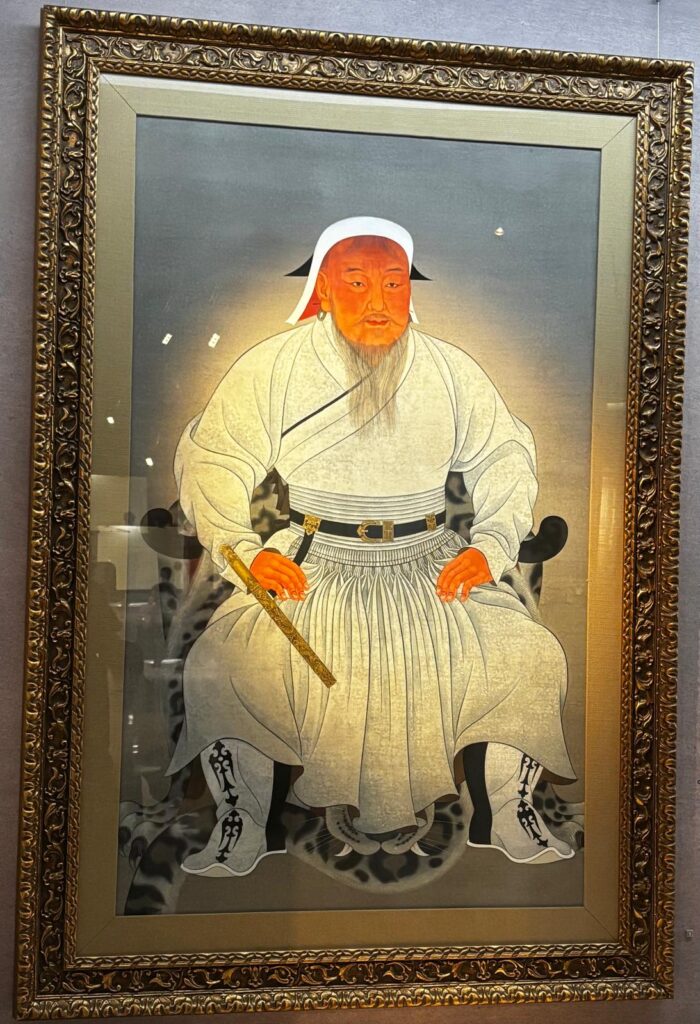
One thing most commentary on him has not actually done is look at what Molor-Erdene has written. He offers a principled critique of identity-based belonging. In his Yesterday, Today, and Tomorrow trilogy, he warns, ‘The “biological” era of blood ties and wanting to know who you are has begun.’ (Tsus oirtokh bolon khen gedgee medmeer baina gesen ‘biologiin’ tsag üye ekhelsen.) To further Molor-Erdene’s point: Why should anyone need to know, or prove through state documents, who they are, to be a political subject? One does not need a microscope to see the tincture of blood in liberal democracies. Molor-Erdene’s critique of Chinggis Khan is also worth considering: what kind of political symbol is Chinggis Khan? What political possibilities is he retrofitted to support, imagine, and foreclose? Are these yours?
I devote one of my seminars to Chinggis Khan and the historical battles over his legacy. In it I discuss how, at different points in history, Chinggis Khan has meant different things to different people. In Mongolia, he is now viewed as the founder of the Mongolian people and state; during the socialist period, by contrast, he was cast as a feudal tyrant. Across the border, in Inner Mongolia in the 1930s, the Communists claimed Chinggis Khan as an anti-colonial hero, only later to repudiate him during the Cultural Revolution. Further afield, in the late nineteenth century, a Japanese student at the University of Cambridge wrote a dissertation claiming Chinggis Khan was Japanese, prompting imperial expeditions into Siberia to find proof. I usually end the class with the trailer for John Wayne’s racist, tragicomic portrayal of Chinggis Khan in The Conqueror. Chinggis Khan has never been a stable referent.
But the Mongolian state needs Chinggis more than Chinggis needs it. Every new populist needs his own Chinggis. Former president Kh. Battulga was behind the world’s largest equestrian statue of Chinggis Khan, in Töv Aimag — though he built it as a businessman, years before he entered the political scene. More recently, the Ministry of Education, Culture, Science, and Sports unveiled the Chinggis Khaan National Museum: the building is nine storeys of marble and concrete; a golden falcon perches on top of the dome designed to look like a Mongolian ger. Visitors enter the museum through its imperial façade and gilded doors, which resemble the signature of imperial authority. On the top floor, for an extra fee, one can sees a 7.5-metre golden Chinggis Khan. It was enshrined in a state ceremony in March 2025 — consecrated with soil from Mongolia’s thirteen sacred mountains and attended by the president, the prime minister, and the speaker of parliament. Trump has the same taste for gold; populism, on either side of the Pacific, speaks of a metallurgic desire. It is an architectural obscenity.
This is at a time when China is folding Chinggis Khan’s memory into its own Sino-civilizational-multi-cultural fantasy and erasing the last vestiges of minority national (minzu) autonomy and language in its own quest for national rejuvenation. One nation’s independence myths are another nation’s extinction myths. As I write about in my forthcoming book, Steppe Immunity: Reimagining Political Futures from Mongolia, extinction anxieties drive national attachments, foreclosing alternative political futures. The problem may not be Chinggis Khan, or even the states that keep reinventing him. It is the nation-form itself that requires the policing of identity, history, and movement.
This is the sacred line of national immunity that Molor-Erdene is criticised for crossing. On social media, many comments have approved of the government’s actions. One representative comment ran: ‘I support freedom of speech. However, this case is not about freedom of speech. This man is attacking Mongolia’s independence…’ Say whatever you want, but do not question the nation. Another person suggested: by denying the historical fact of Chinggis Khan and the Mongol people, Molor-Erdene has left the protected realm of free speech and academic debate and is engaged in ‘slander.’
The common liberal rejoinder went: ‘I don’t agree with what Molor-Erdene says but I will defend his right to say it.’ There is palpable worry that Mongolia’s legal protections are being peeled like clementines, one after another. But is there a way out of this dialectic of liberal free speech versus nationalist slander? There is, but it is not one that fits within nationalist historiography—it is only visible by the faint light from a star that has since disappeared.
Complicating matters further is the usual intrigue and opacity of Mongolian politics. An unlikely Socrates, Molor-Erdene has ambitions to run for president. Speculation has been rampant whether he is a pawn of a larger electoral game, always being played behind the scenes. The person leading the charge against Molor-Erdene, S. Amarsaikhan, last month announced a new policy of social media registration, copying China’s playbook; each social account would be linked to a personal identity number. Perhaps Molor-Erdene is an early victim of what such a policy portends: a fly stuck in a turbid ointment. The latest news on this issue is that he is being detained for a month, pre-trial.
A friend said to me this morning: ‘This whole thing is a farce,’ which does not mean it is without consequence. It is a scandal commensurate with the times in which we live.
Christian Sorace is Associate Professor of Global China at the University of Cambridge and a Fellow of Corpus Christi College. He is the author of Shaken Authority: China’s Communist Party and the 2008 Sichuan Earthquake (Cornell 2017) and of the forthcoming Steppe Immunity: Reimagining Political Futures from Mongolia (Stanford, 2027). He co-edited Afterlives of Chinese Communism: Political Concepts from Mao to Xi (ANU Press and Verso, 2019) and Proletarian China: A Century of Chinese Labour(Verso, 2022). He also serves on the editorial board of the Made in China Journal.