


On August 26th, a powerful billow of wind coursed through the Lende River valley at the border between China and Nepal, tearing trees from their precarious cliffside holds. Seconds later, a debris flow of liquified glacial ice and rock shot through the valley, scouring the landscape and gaining speed and material as it flowed downstream. Reaching speeds upwards of 180 kilometers an hour, the debris flow would wipe out entire towns and devastate roads and hydropower stations. Thousands would be tragically buried under a cascade of water, rock, silt, twisted rebar, and concrete.1
The economies of the affected Nepalese towns closest to the border are oriented towards tourism and the work of business logistics. Rasuwagadhi, the first populated area to be destroyed by the Lende-Bhotekoshi-Trishuli River catastrophe, is one of a handful of border crossing areas that has emerged as an urbanized corridor supporting Sino-Nepalese trade and dominated by the importation of Chinese goods.
The tragic deaths of residents in the towns of Timure, Ghatekhola, and Syaprubesi – all part of Nepal’s Rasuwa District – are inextricably linked to the presence of the logistics corridor. The concentration of peoples in the lower valley, just proximate to the river, was not an indigenous settlement pattern but stemmed from the creation of labor opportunities tied to the off-and-on again border junction. The logistical connection between China and Nepal produced new social and commercial spaces that sat uneasily amid a landscape sensitive to climate change and the continuous erosion of natural and artificial surfaces. Moreover, through its current geopolitical and geoeconomic strategy, China is waging an on-going war on the Himalayan landscape through logistical deployment. Given intractable environmental unpredictability and technological limitations, this war places many Nepalis in death’s way.
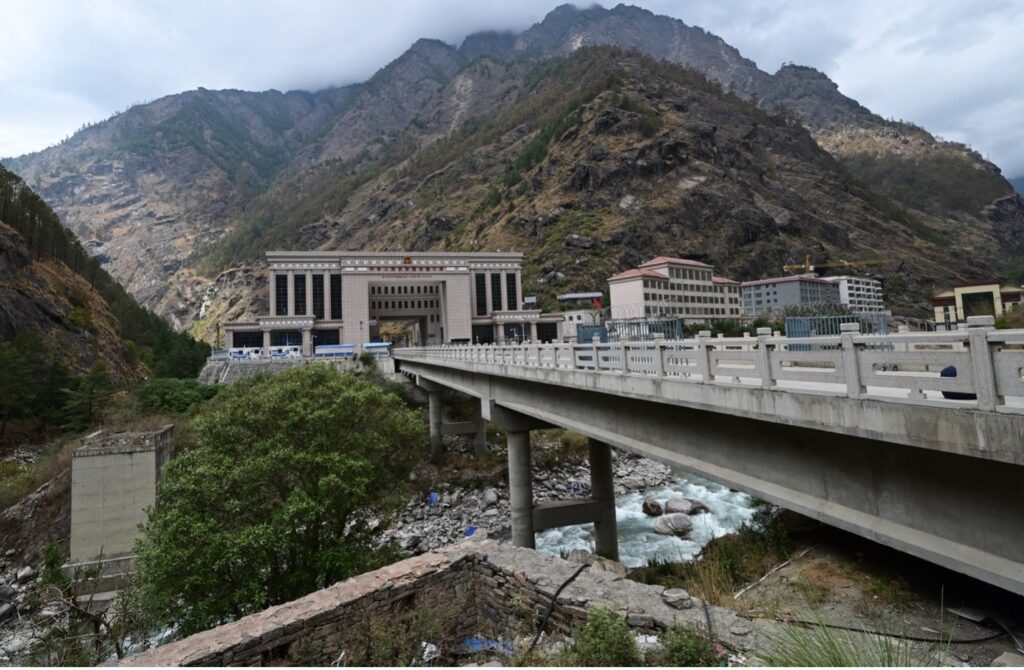
Chinese commitments to outward development are rooted in a cluster of economic and political priorities. Chinese domestic manufacturers need external markets to maintain their growth and success, and the Chinese state consolidates and projects its sovereignty through the construction of infrastructure in its borderlands (Ye 2020; Leibold 2026). Border connections to neighboring countries require securitizing borderlands territories, building and rebuilding infrastructures, and making territorial edges more reachable by the state.
Beyond economic and political domination, the development of Chinese-linked infrastructure and trade flows brings a mixture of propaganda, coercion, and mundane familiarity with China to neighboring states. Logistics thus supports an emergent geopolitical order for the “Community of Shared Destiny” (Ch. mingyun gongtongti), in which, theoretically, all countries entangled in China’s development programs enjoy shared prosperity. The Nepalese government also desires the trade flows and development that connections to China provide. Import duties, particularly on EV cars, form a significant portion of national revenue. Indeed, natural disasters like floods and landslides have been shown to have measurable negative impacts on Nepal’s public revenue (Khatri et al. 2026). Cooperation with China has also helped successive Nepali governments balance the mercurial relationship with India, which has used its influence to punish Nepalese governments for their relationships with the Chinese government and Chinese firms (Murton and Lord 2017). Balancing the relationship between China, India, and powerful states outside the region are part of contemporary strategic statecraft, so it is a mistake to reduce contemporary Nepali politics to the Chinese sphere of influence (DiCarlo and Paudel 2025). Nonetheless, the relationship with China provides massive amounts of cheap goods that can be found in homes, restaurants, businesses, restrooms, and other milieux of everyday life. China’s growing influence in politics and life is undeniable.
Before the August 26th disaster, known as a gangbal in the Tamang language, Rasuwa could have been considered a showcase for logistical connection. Concrete, asphalt, and bridges had enabled container trucks, painted lorries, and EV cars piloted by locals to make the crossing between the two countries. Chinese developers were behind the dry port and recently completed customs hall. From these developments, new businesses were able to form, and new patterns of livelihood had taken hold. Residents new and old worked with the Ward Chief for opportunities to labor at the Dry Port, sharing the payment for packing and unpacking trucks. For these laborers, the Dry Port in Timure was an alternative to meager farming incomes or alternatives such as moving to Kathmandu, a Gulf State, or Europe. Families strategized about who would go where and how to find income. For those that stayed behind in Timure, or that moved in from surrounding rural areas, it was important to be close to the Dry Port to participate in any economic activity. Subsequently, farmers descended from the upper farms to river-side housing and outsiders rented cheap rooms along the road. The logistical route became an urban corridor exposed to disaster.
Logistics is violence. The science of business logistics is genealogically connected to military development, and its prioritization in contemporary capitalism has produced new modes and manners of violence (Cowen 2014). If logistics has helped wage “social war” on organized labor, it has also invited, enticed, and entrapped populations around the world into dangerous labor environments on container ships, fishing trawlers, and in mines, factories, and warehouses. It has also, as the case of Rasuwa makes clear, trapped laborers in dry port-adjacent urban corridors. These corridors are sites where Chinese construction firms wage a continuous war against montane geology. By blasting and leveling, cementing and reinforcing, construction firms open the supply routes for Chinese imports to pour into Nepal.
Achille Mbembe (2019) has argued that one site of the emergence of modern sovereignty is the separation of the human subject from nature and the linking of the colonized subject to uncivilized nature. Twentieth-century Marxist states saw nature as an object to be tamed, sometimes with great violence and lethal human exertion, such as the Soviet Transpolar Railway. Natural environments and prison-laborers were both destroyed in efforts to overcome technically difficult permafrost conditions. Contemporary capitalism, in all its varieties, also tames nature, offering environmental assessments and land compensation to ameliorate the violence of logistics.
On the one hand, China’s infrastructure projects on the Tibetan Plateau and in the Himalayas have been successful. Before 2006, there were many critics of the Qinghai-Tibet Railway, at that point terminating in Lhasa. Permafrost conditions were to make the undertaking an impossible feat: cyclic freezing and thawing presented risks. Ultimately, engineers devised diverse active and passive tools to stabilize permafrost cooling and heating, including 36 kilometers of sunk thermal piles (Qin and Zheng 2010). More recently, rail-building projects in western Tibet have enabled logistical connection between Lhasa and Shigatse. Today modern tarmac highways connect that city to the town of Kyirong, near the border with Nepal, and up to Rasuwagadhi itself. China CAMC engineering has submitted feasibility studies for rail connections to Kathmandu and Tibet Tian Lu Company Limited (Mulmi et al. 2023) was rewarded a Chinese-financed contract to widen and pave the road from the Rasuwagadhi border to Syaprubesi. Combined with the dry port and border security cooperation, a key objective has been to eliminate logistics frictions between the two countries. Trade between China and Nepal has increased significantly over the last decade, as Chinese exports have more than doubled while Nepal’s exports have remained stagnant. Chinese SOEs have also been the big winners for construction projects, with investments typically being conditional on their execution by Chinese firms (Mulmi et al. 2023).
On the other hand, on-going development has carved-up alpine meadows in Tibet, exposing soils to more erosion. In Nepal road and hydropower development destabilizes cliffsides. Simultaneously, cryosphere geographies, are subject to global climate necropolitics (Sultana 2022; DeBoom 2021). In the Himalayas, glaciers are rapidly melting away, opening rock faces and glaciated soils to erosion. Between the war of logistics and the anthropogenic destruction of Himalayan glaciers, the landscape of the Himalayas suffers slow violence, a siege of geographic integrity that places local populations in a state of precarity as they live in the shadows of the supply chains they service. Unlike economies of climate necropolitics that despoil spaces and injure laborers where crucial minerals can be extracted for the green supply chain, the necropolitics of Sino-Nepali logistics shifts rapidly from a slower structural violence to sudden calamity, such as the recent gangbal.
The necropolitics of supply chain logistics must be understood in relation to its biopolitical counterpart (Peters, et al., 2025). At the Sino-Nepali border at Rasuwagadhi, China had loomed large as it conducted the conduct of the border. During my fieldwork there in 2024 and 2025, I learned about pervasive CCTV, secret agents, extraterritorial “concerns” over activity across in Timure, and occasional beatings of Nepali citizens. Chinese activities concerned with Nepalese citizens’ conduct sought to discipline social activity and thereby smooth the circulation and ensure supply chain security. The PRC’s Ministry of Finance promoted development projects that have now been washed away, including the dry port and primary schools.
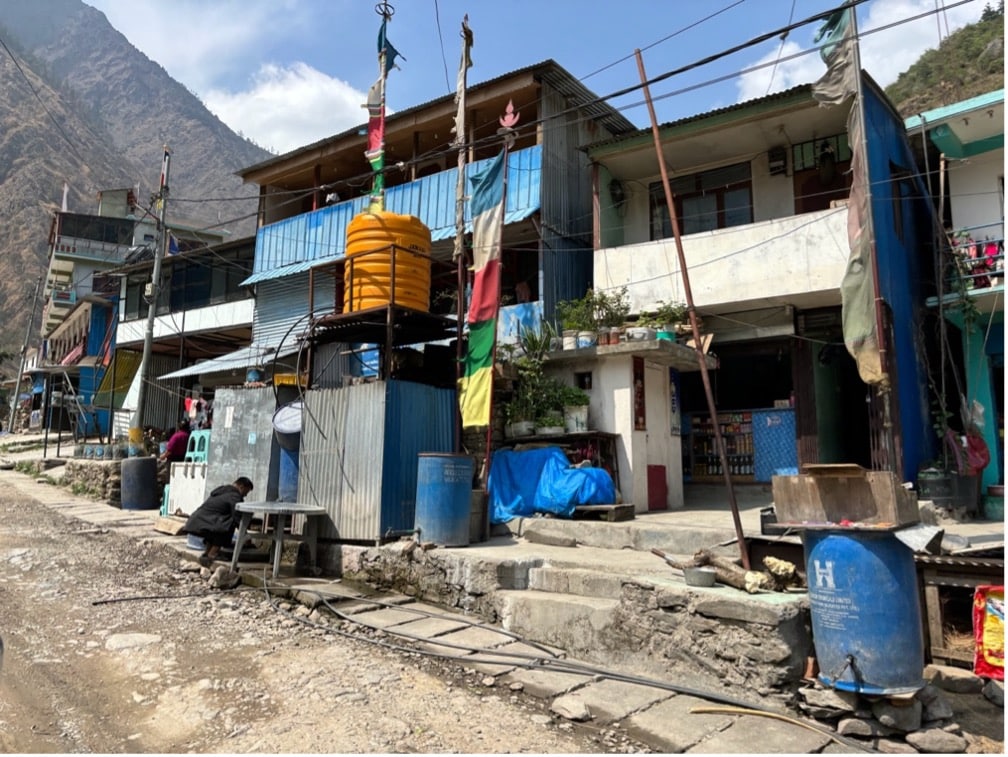
If China is concerned about the life of Nepal’s citizens near its border, and seeks to include Nepal in the Community of Shared Destiny, why the exposure to death? The answer likely lies in the geopolitical and geo-economic goal of expanding Chinese influence among its neighboring states and in breaking Indian hegemony in South Asia (Grant 2025). To accomplish this, logistics must exercise sovereignty over Himalayan landscapes. The most important part of the life-sustaining circulations that China seeks to enliven are an expansion of a Sino-centered geo-economic sphere. In the view of Chinese developmental authorities, nothing must stop deepening economic entanglement, despite ongoing problems with an unstable landscape that reshapes with every monsoon season. Deadly incidents like the 2015 earthquake and the 2025 destruction of the Rasuwagadhi border-spanning bridge have only served to encourage further the war of logistics on the environment, rather than deter efforts at reconstruction.
The promise of infrastructure in the high Himalayas, crossed by narrow gorges, capped with a sensitive cryosphere, subject to seismic activity, and soaked by the unpredictable rains of the monsoon season, necessitates technological advancement, confidence, and prudence. As Nepal’s public works projects have lagged behind, the Chinese have seemed to possess all of this. The war against nature is a war they appear ready to wage. There are positive outcomes of this disaster. Strong connections exist between Nepali and Chinese authorities and scientists that sharpen and improve disaster prediction and response. Environmental and technical collaborations can be viewed viewed as forms of ‘deep neighboring’ that can even help local concerns in these borderlands reach the state (Saxer 2023). Recent assessments have provided ways forward to mitigate GLOF disasters and even blast newly formed lakes to prevent the destruction of future communities.
Nevertheless, the August gangbal disaster demands we acknowledge the realities of logistical and climate violence. Border connectives create urban corridors into which Nepal’s rural populations have migrated. No amount of political confidence or engineering techno-solutions seem able to overcome the sheer challenge posed by Himalayan topography and its melting glaciers. Today, Nepalese authorities are appealing to the United Nations, China, and other sources to help rebuild devastated areas. The economic dependency that trans-Himalayan logistics has created between China and Nepal seems to necessitate that logistical links are rebuilt, bigger and better than before: the Community of Shared Destiny must be forged.
Yet with the resuscitation of this biopolitical circulation returns the specter of the necropolitical: the new Chinese order in South Asia is being built upon the destruction of Himalayan environments. The logistical war on Rasuwagadhi’s landscape is one that will be “won” only at great cost, as new blasting, bulldozing, and paving amid a collapsing cryosphere continues to expose borderlands peoples to disaster death.
Andrew Grant is Assistant Professor of Geography in the Department of History, Geography and Legal Studies at the University of Tampa
References
Cowen, Deborah. 2014. The Deadly Life of Logistics: Mapping the Violence of Global Trade. 1st ed. University of Minnesota Press.
DeBoom, Meredith J. 2021. “Climate Necropolitics: Ecological Civilization and the Distributive Geographies of Extractive Violence in the Anthropocene.” Annals of the American Association of Geographers 111 (3): 900–912. https://doi.org/10.1080/24694452.2020.1843995.
DiCarlo, Jessica, and Dinesh Paudel. 2026. “Infrastructural Polyalignment and Himalayan Geopolitics: Subjugation, Small-State Agency, and Regional Competition in Nepal.” Third World Quarterly 47 (13): 2727–45. https://doi.org/10.1080/01436597.2025.2522292.
Grant, Andrew. 2025. “Expanding China’s Geopolitical Influence through Peripheral Communication – Mapping China’s Strategic Space.” Borderlands. Mapping China’s Strategic Space, August 13. https://strategicspace.nbr.org/expanding-chinas-geopolitical-influence-through-peripheral-communication/.
Khatri, Abiral, Austin Lord, and Jakob Steiner. 2026. “Climate Risks to Nepal’s Energy Transition: Loss and Damage from a Glacial Lake Disaster Disrupting the Trans-Himalayan EV Supply Chain • Stimson Center.” Stimson Center, August 4. https://www.stimson.org/2026/climate-risks-to-nepals-energy-transition-loss-and-damage-from-a-glacial-lake-disaster-disrupting-the-trans-himalayan-ev-supply-chain/.
Leibold, James. 2026. “Infrastructure Nationalism and Sovereignty by Settlement in Tibet: The Case of Xiaokang Border Villages.” China Information, September 17, 0920203X261477237. https://doi.org/10.1177/0920203X261477237.
Maskey, Aayush, and Suloja Khadka. 2024. “Pandemic Pulse: A Comparative Analysis of Nepal-China Import-Export Trends Pre-and Post-COVID (2015-2023).” SSRN Electronic Journal, ahead of print. https://doi.org/10.2139/ssrn.5021962.
Mbembe, Achille. 2019. Necropolitics. Duke University Press.
Mulmi, Amish Raj, Arpan Gelal, Anil Giri, Raunab Singh Khatri, and Milan Acharya. 2023. China’s Emergence in Nepal’s Infrastructure: Status, Issues and Challenges. Centre for Social Inclusion and Federalism (CESIF).
Murton, Galen. 2016. “A Himalayan Border Trilogy: The Political Economies of Transport Infrastructure and Disaster Relief between China and Nepal.” Cross-Currents: East Asian History and Culture Review 1 (18): 97–109.
Murton, Galen, and Austin Lord. 2020. “Trans-Himalayan Power Corridors: Infrastructural Politics and China’s Belt and Road Initiative in Nepal.” Political Geography 77 (March): 102100. https://doi.org/10.1016/j.polgeo.2019.102100.
Peters, Freya, Nick Clare, and Thom Davies. 2025. “Necropolitics and Geography.” Progress in Human Geography 49 (5): 466–88. https://doi.org/10.1177/03091325251348613.
Qin, Yinghong, and Bo Zheng. 2010. “The Qinghai–Tibet Railway: A Landmark Project and Its Subsequent Environmental Challenges.” Environment, Development and Sustainability 12 (5): 859–73. https://doi.org/10.1007/s10668-009-9228-x.
Saxer, Martin. 2023. Places in Knots: Remoteness and Connectivity in the Himalayas and Beyond. Cornell University Press.
Sultana, Farhana. 2022. “The Unbearable Heaviness of Climate Coloniality.” Political Geography 99 (November): 102638. https://doi.org/10.1016/j.polgeo.2022.102638.
Ye, Min. 2020. The Belt Road and Beyond: State-Mobilized Globalization in China: 1998–2018. Cambridge University Press.
Youth Innovation Lab. 2026. Mountain Tsunami. Kathmandu.