


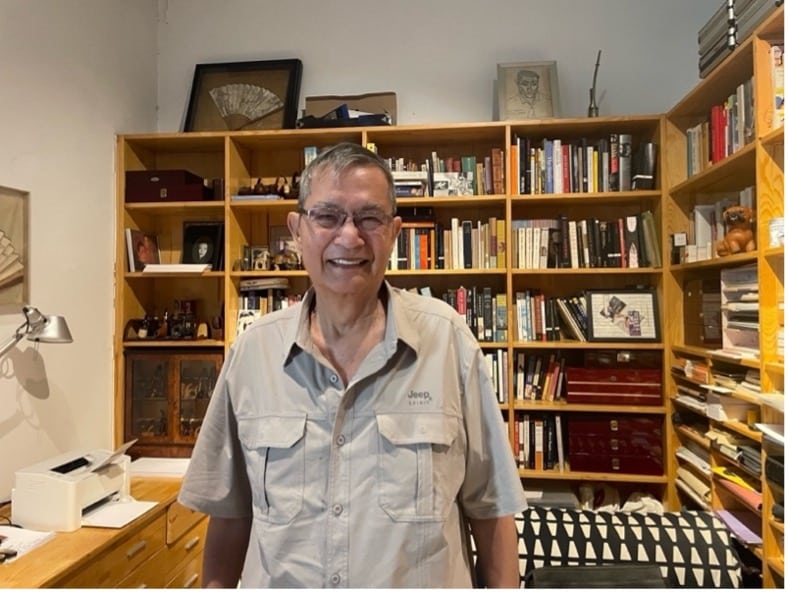
I received my PhD in Comparative Literature at UC Irvine under the guidance of Ackbar Abbas. When I was encouraged to write a personal reflection in memory of Ackbar, my initial reaction was reluctance. To me, it was an impossible task. Not because I wasn’t close to Ackbar, but quite the reverse. I had taken many seminars with him, TA’ed for him, typed for him, and spent numerous hours in conversation with him. I was also fortunate to see him every year—in Irvine and Beijing—from the year of my admission to grad school until January 2026. However, to respond to the boundless spirit of his mind and to unpack the deep bond of our mentoring relationship in words simply felt like: how might it even be possible to draw the universe in a painting or seize the stars from afar?
And yet, I became convinced after further prodding that even my struggle to write the impossible would itself be meaningful to reflect on Ackbar’s teaching and thinking. This is a theorist who, in the past several years, was thinking extensively about failure and refusal in company with Walter Benjamin, Franz Kafka, and Samuel Beckett. Compelled by contemporary cultural conditions in Hong Kong and the world, as well as his own inability to return from Irvine to Beijing and re-unite with his wife Liu Sola during COVID-19, failure and refusal appeared as regular motifs in his class lectures, emails, chats, and in his last pieces of writing. To him, thinking itself is an act of struggle against the possibility of its own failure; it makes turns and refuses to give in to the realities of life. This endeavor was similar to another topic we often discussed extensively—the workings of documentary film: when the documentary hits a representational impasse, the solution is not to turn away but to take on documentation more forcefully so as to struggle with limits and engage with the impossible.
In practice, Ackbar’s teaching about failure happened several times during my time in grad school, when he’d respond to my writer’s block very kindly by saying, “It’s fine. You don’t need to give me thirty pages. Just bring a few paragraphs. I am here to think with you.” I am here to think with you… That is to say, I am here to share your struggle… You can fail, but you are not alone.
In the spirit of immense intellectual companionship, trust, and generosity instilled by this act of thinking-with, I write with personal memories that have been replaying in my mind in the past several months. In the course of following heartbreaking updates about Ackbar’s health conditions through Gabriele Schwab, my other mentor, and constantly feeling the ache of not being able to see him in Beijing this past summer, I know that thinking-with is the least I can do, but it is also the most possible so as to carry on with Ackbar’s cheerful and indefatigable spirit.
An Uncanny Journey
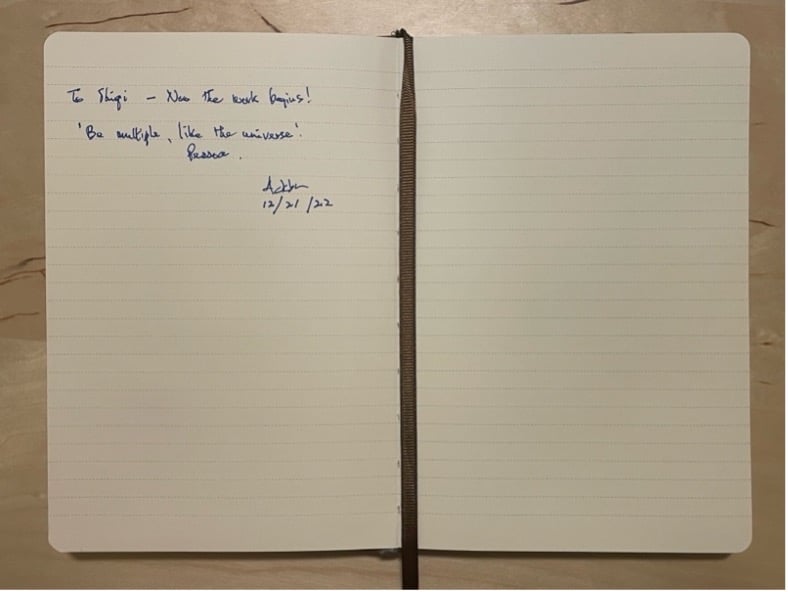
Studying with Ackbar had a mind-boggling start: I learned that he, a sophisticated theorist of new media and digital technology, didn’t know how to type. Even more dramatically, I once received a nickname, “ship”—yes, in lowercase—thanks to the autocorrect function of his email. This is the same advisor who had cut and pasted an image of Walter Benjamin’s Angel of History on the cover of a notebook, as if he himself were living like the Angel fiercely resisting the storm of technological progress via his thinking and handwriting. When I discovered this Angel on his notebook, I came to the realization: “Okay, my advisor is a living ‘anachronism’ and ‘Baroque allegory’ analyzed by himself.” Since then, I observed again and again how it was a live contradiction, a quiet life, and the critical distance that he had intentionally curated between himself and the external world that allowed him to produce some of the sharpest and most interesting critiques of technology and cultural politics. It was amusing, as well as enlightening, that he was already talking about the eccentric thinker Byung-Chul Han as a crazy philosopher (as if he himself were not crazy enough!) as early as 2018; he was already quoting Han’s critique of social media as a “shitstorm” at a time when pre-pandemic digital discourse was largely utopian and forward-looking.
In the Winter 2020 quarter when I was TA’ing for him in the middle of the COVID-19 outbreak, “how would my advisor use Zoom and get groceries” was a question that unnerved me just as much as the question of “where could I still find masks and Clorox wipes.”
During the pandemic years when he was stranded in Irvine, we had quite a number of marathon meetings that often lasted an entire morning or afternoon to discuss my writing drafts word by word, line by line. In spite of the anxious and violent time, the shared space of sincere and dedicated thinking offered me an invaluable source of calm and focus. Regardless of who he was speaking to and what topic was at hand, he upheld the same standard for every piece of writing: thinking had to reach its highest level of precision. Often, my inquiry about one word in my writing would turn into a thirty-minute discussion, with me asking him to re-iterate an idea three times or us debating big questions, such as whether “postcolonialism” or “neoliberalism” is (still/ever) an adequate framework to theorize contemporary China and East Asia. During those meetings, I brought mooncakes and dim sum, and he, in turn, offered his carrot juice, coconut water, a variety of teas, his favorite black sesame candies, along with his childhood stories of Hong Kong snacks. These sessions form some of my most cherished memories of the pandemic.
In 2023, I graduated from Irvine. This was around the same time that he finally achieved his dream of reuniting with Sola in Beijing.
As my parents also live in Beijing, I became one of the handful of lucky ones who maintained close contact with Ackbar and continued to see him every year after his retirement. It had already become my routine practice to see Ackbar during my every family visit back to Beijing. He is part of my family. Each trip to Ackbar and Sola’s lovely siheyuan residence from my parents’ place was a three-hour journey from the southwest of the city to the northeast end, switching between bus, subway, and Didi, until it became muscle memory to tell where I was in the journey.
I now have to grapple with the question of what it means that neither Beijing nor Irvine will be the same the next time I go back.
“I am a Hong Kong boy!”
One of my favorite memories about Ackbar dates from 2022 in Irvine, when a new friend, a visiting scholar and seasoned local from Hong Kong, asked to see him. At the university Peet’s Coffee where we met, Ackbar wore a baseball cap and responded to the friend’s query about his Hong Kong roots. He chatted about the local shops and schools in Kennedy Town from his childhood, some of which even pre-dated the friend’s knowledge, and he smiled gleefully: “I am always a Hong Kong boy!” It made me wonder: for those who have revered him as an academic tsar in conferences and lecture halls, could they ever have imagined this carefree boyish person behind the theorist?
Although I never crossed paths with Ackbar in Hong Kong, I was familiar with his legendary status and continuing enormous impact in the city. (According to him, even the flamboyant singer and actor Leslie Cheung, his ex-brother-in-law, looked up to him as a childhood hero.) In our conversations in Irvine and Beijing, Hong Kong came up regularly—usually prompted by my strong curiosity to ask him to share more—as a window into his fascinating past; as a node of urban interconnection; as a point of reference for theorizing contemporary global cultural situations; and as a paradigm of doing critical theory and cultural studies. Directly or indirectly, these conversations have sparked my long-term interest in thinking through Hong Kong.
Internationally recognized for his seminal book, Hong Kong: Culture and the Politics of Disappearance (1997), Ackbar is known for anatomizing the cultural politics of the layered city at its moment of handover from Britain to the PRC. However, for Ackbar, the relevance of Hong Kong went far beyond its actual geography and the 1997 moment. I always appreciated the times when he talked about his grandparents from Malaysia, India, and Cambodia (Cambodian Chinese), as well as his father’s wartime experience as a displaced refugee. As a living allegory of the making of modern Asia, his family story stands as a symbol to me for why Hong Kong is and will always remain a unique place for thinking about the world and cultural theorization: not because it’s an Asian or global financial center, not because of its interstitial status between British colonialism and PRC rule, but because it has always been a node of intercultural crossings, a murky grey zone, and a critical switch point that preserves its ambiguity and shelters people from all walks of life for making and re-making habitats in regenerative ways. In Ackbar’s words, Hong Kong is special not because it tells of local identity that should be essentialized, but because it manifests a larger cultural situation of dis-location—dis-location as both a global symptom of sociopolitical change and a strategy to rewrite the global contemporary.
In Ackbar’s teaching and writing after Hong Kong, this attentiveness to dis-location remained deep in his thinking and served as a capacious method when his analysis expanded into new cinema, digital media, urbanization, and a paradigm of globalization that runs on the logic of the fake in China, Africa, and the Global South. From Hong Kong to post-socialist China and, inevitably, to the post-2016 United States whose technopolitical changes have baffled and mattered to the world in a myriad of ways, Ackbar’s insights on not just contemporary social changes, but the changing nature of these changes in a shifting structure of global political economy, have proved time and again prophetic: it is not change that has changed, but the frames and coordinates through which change takes place that have changed.
I was very lucky to work with Ackbar at a time when the geographical focus of my doctoral research—contemporary China—aligned with much of his work and concern of the last two decades. The theoretical problematics of a fast-changing China organically chimed with many symptoms of Hong Kong that he had scrutinized, and he repeatedly encouraged me to see that understanding contemporary China and its mutating, intertwining relationship with the U.S. is indispensable to understanding the present and future of the world. With an emphasis on dis-location rather than exceptionalizing a space, what made his teaching particularly instructive for me is not his reading of an area, but the theoretical questions his work opened up for de-familiarizing our analytical lens of every place. It helps in building new strategies to articulate global social changes associated with translatable questions such as speed, scale, agency, mediality, and the political force of critical inquiry. For many of the students at Irvine, whose topics ran the gamut from Armenia to the Philippines, from literature and cinema to popular culture, he engaged with all our work with a sense of radical receptivity. What we learned from him was not a particular theory or a set focus on a geography, but a stance from which to think, a mode of problematizing the familiar, a way of navigating the world around us.
Living the Unknown
In my last several conversations with Ackbar, I frequently brought up a set of metaphysical questions, secretly praying that the master—in his remote study in Beijing surrounded by his favorites Benjamin, Kafka, Pessoa, Burroughs, Deleuze, etc.—would have the magic power to enlighten me and the world with decades of accumulated wisdom and life experience: “Ackbar, where do you think the world is going? What can my generation do about the collapsing systems everywhere? How do we persist?”
Sometimes he responded with two remarks on the unprecedented challenges faced by universities and the world’s two biggest economies, China and the U.S. Sometimes he recounted how the present time was nothing like earlier days. But more often, he just smiled like a Buddha, “It’s a question for your generation to figure out.”
This was the same kind of smile I got when I told him in the same conversations that my recent research interests had moved to the political histories of dance music, while showing him some flashy and bombastic Instagram reels of mass raves under bridges and inside tunnels. Partly to entertain him, and partly to sneak in questions seriously occupying my mind, I would ask, “Ackbar, what do you make of the hyper-mediality of this? What kind of political space is coming out of this?” Over the years, having patiently and supportively witnessed me explore my interests from documentary to digital media, from science fiction to popular music, sometimes luckily seeing some light through and some other times stumbling and hitting dead ends, he didn’t question my sanity. He just smiled and hinted, “This is interesting, and you have to figure it out yourself.”
This is interesting, and you have to figure it out yourself. Your generation has its own tasks to tackle—and you can’t hide. In these moments, even if Ackbar claimed that the challenges of the present day are exceptional, I found a strange parallel between the time we’re living now and another unprecedented moment—the time that gave rise to his theorization of Hong Kong in the 1990s. In fact, I was often haunted by the opening passage he wrote in the first essay of the first issue of the positions journal in 1993, on the poetry of the Hong Kong writer Leung Ping-kwan: “Living in interesting times, as the old Chinese adage tells us, is a dubious advantage. Interesting times are periods of violent transition and uncertainty” (Abbas 1993: 1). As someone who had navigated his own “interesting times,” he didn’t directly answer my queries, but I think the way he responded to his times with the critical distance to think, to critique, and to generate vocabulary on the sharp edge has already pointed in a direction.
When I think back to his Buddha-esque smiles, it feels as if I were receiving the message, just keep venturing and stumble. Fail, fail better, learn something from your failures, and keep failing. You don’t have to be scared of the unknown. You may have to fail—and that’s how you persist. To fail is to persist. Just as he wrote in one iteration of “failure as resistance”:
We find here not a failure of resistance, but rather failure as resistance; a politics of failure that is not the same as a failed politics and that has its own kind of heroism quite different from other kinds of heroism. […] In the volatile spaces of today, our motto may have to be: Dare to fail. Failure, we might say, is the moral heroism of our time, in social life as well as in our art. It is what allows us to continue under conditions of impossibility. To act, not because we have hope, but because we refuse to give in to despair.
Mission Accepted
After Ackbar’s passing, a few of us—friends, students, and former colleagues who have benefited immeasurably from his thinking and spirit—have been talking about how to properly remember and carry on his legacy in comparative literature and critical theory. To imagine an event and a material form of our remembrance, just like my struggle to piece together my thoughts and memories for this essay, feels impossible, because we all know that Ackbar hates cliché, hates both sentimentalism and formalism, and hates it when theory is deified rather than subverted. On a conceptual level, he is also giving us headaches such as “how can you embody ‘poor theory’ through an art performance” or “how can you really explain his mysterious cosmological thinking of the ‘quantum image’—the topic of the last grad seminar he offered at Irvine.” However, no matter what format we will eventually come up with, there is one thing I am sure of: we will take on the task of the impossible. As Ackbar taught us, theory cannot be reproduced as clichés, but must be meaningfully and playfully lived, performed, smashed, and re-invented at its edge. As such, I know that the spirit of Ackbar will stay longwith us, closely and profoundly, in the way we think, write, live, and grieve. We will miss you, Ackbar.
Acknowledgement
This article is written for both positions politics and Department of Comparative Literature, UC Irvine. I thank Rebecca Karl and Adriana Johnson for kindly nudging me to process my memory of Ackbar through this personal reflection. I thank Gabriele Schwab for sharing the grief and encouraging me to write for Ackbar. I thank friends who have been processing memories with me in the past several weeks.
Shiqi Lin received her PhD from UC Irvine in 2023; after a post-doc at Cornell, she is now Assistant Professor of Chinese at the University of Rochester. She is working on a book entitled Documentation as Transmedial Relay.