Check out our paideia section - Winner of the CELJ 2024 Best Digital Feature Award
Siyu Xie shows how lychee fans grow pink leaves in dim light, rethinking green as ecology’s dominant color.
Siyu Xie
P i n k . L y c h e e . L e a v e s
De-centering Green
Lychee enthusiasts are cultivating pink, not green, leaves from lychee, a native Asian tropical plant whose translucent, aromatic, floral, intensely sweet fruit pulp has fascinated people for millennia. In recent years, lychee cultivation has gone viral on RedNote (小红书), a social media platform in China. With the arrival of summer lychee season, amateur plant cultivators share their experiences growing lychee sprouts and leaves in water-based setups at home or on office desks. They buy lychees from the market, eat them, wash off the remaining pulp from the pit, and place the pits in water.
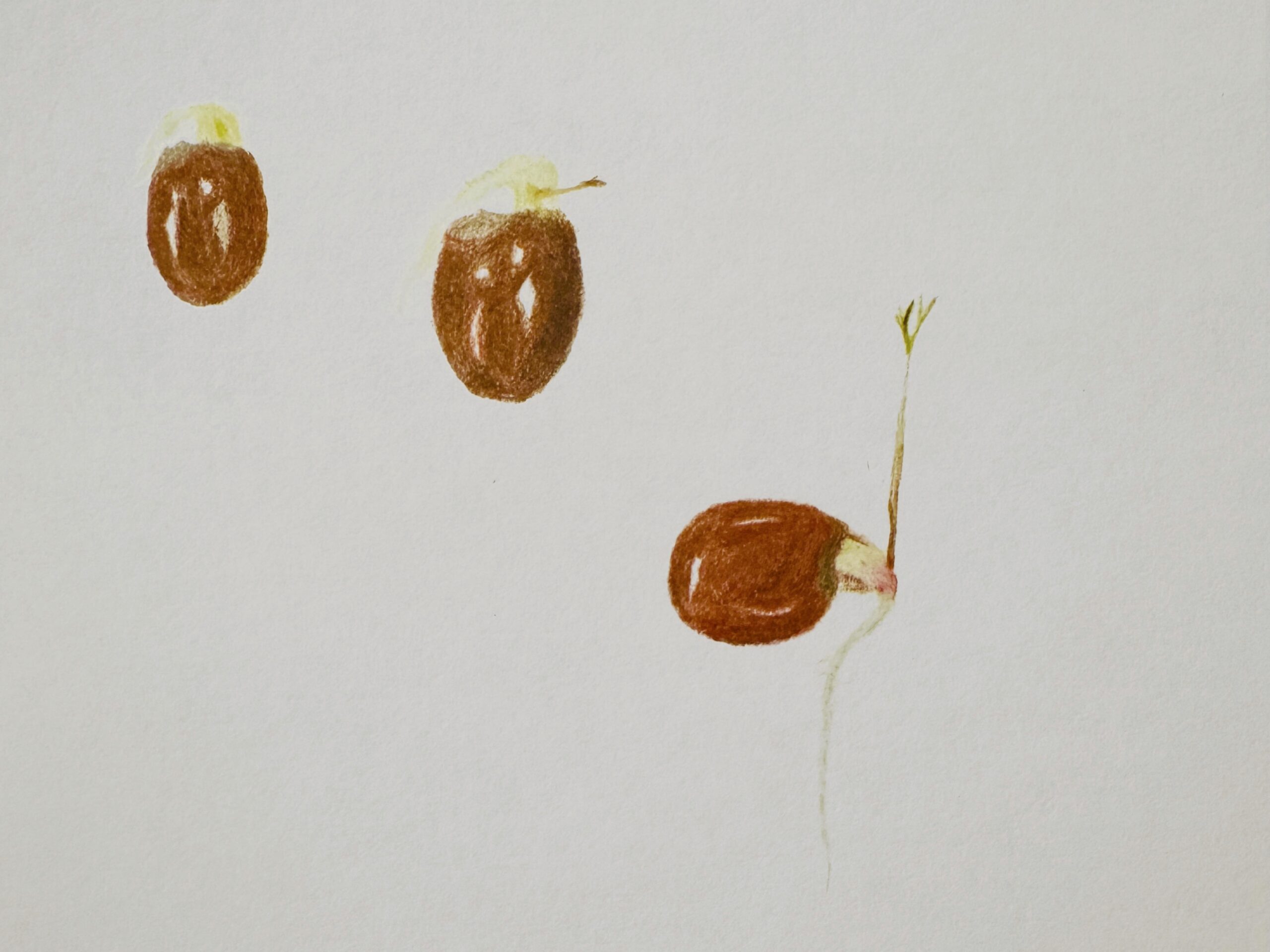
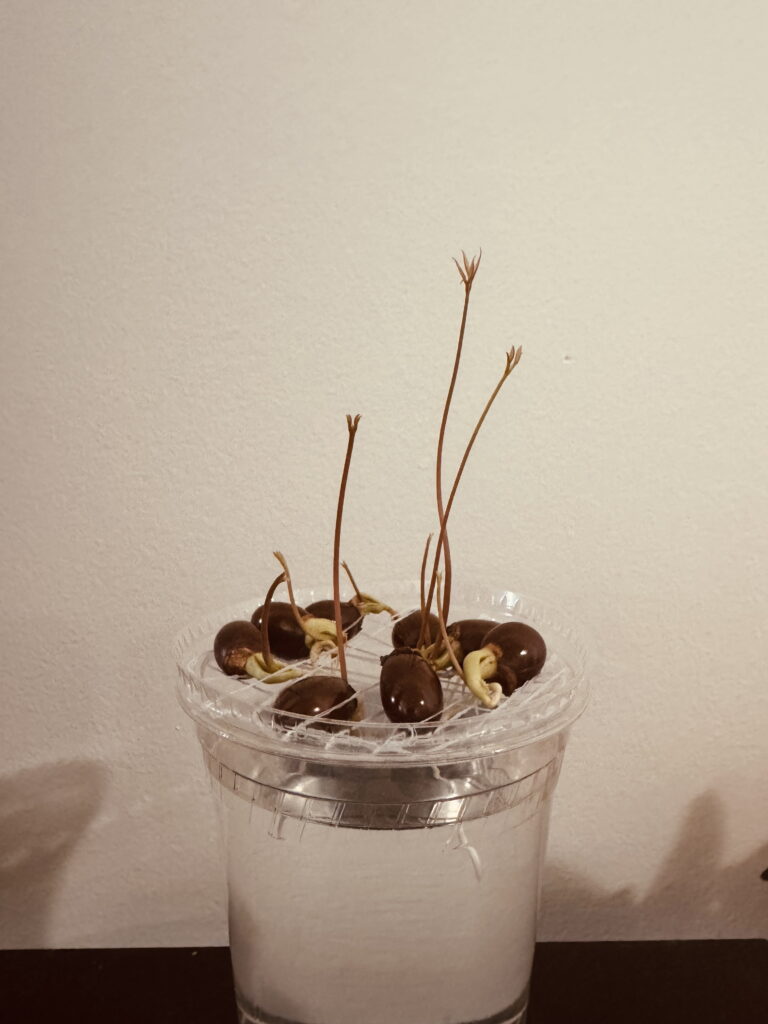
Following their practice, I bought lychees from H Mart and replicated their experiment. After about three days, the pits crack and something starts to grow. I looked up the nomenclature of pit parts and found that it is called the “radicle.” Cultivators often transfer the lychee pits to a box layered with paper towels soaked in water. After another three or four days, a thin white-greenish root starts to extend out of its shell. When they reach one inch long, the pits need to be moved to a place with water. The lychee enthusiasts love to use recycled coffee cups. Usually there should be a net just above the water level so the roots can reach the moisture below without getting the pit damp. After a few days, a tiny sprout comes out of the part connecting the root and first stem—this is its hypocotyl.
Figure 1: my colored pencil drawing sprouting lychee pits, 08/19/2025
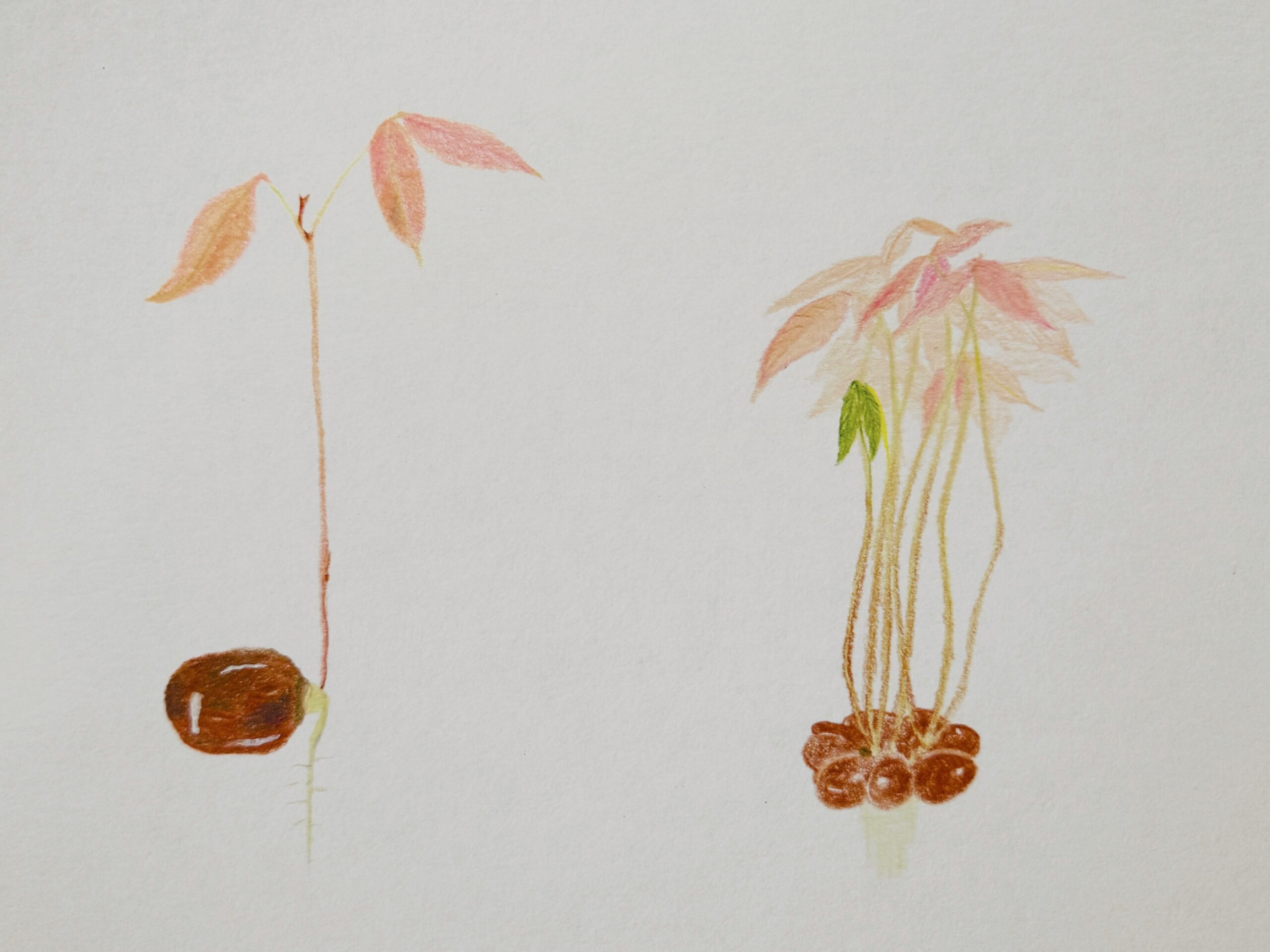
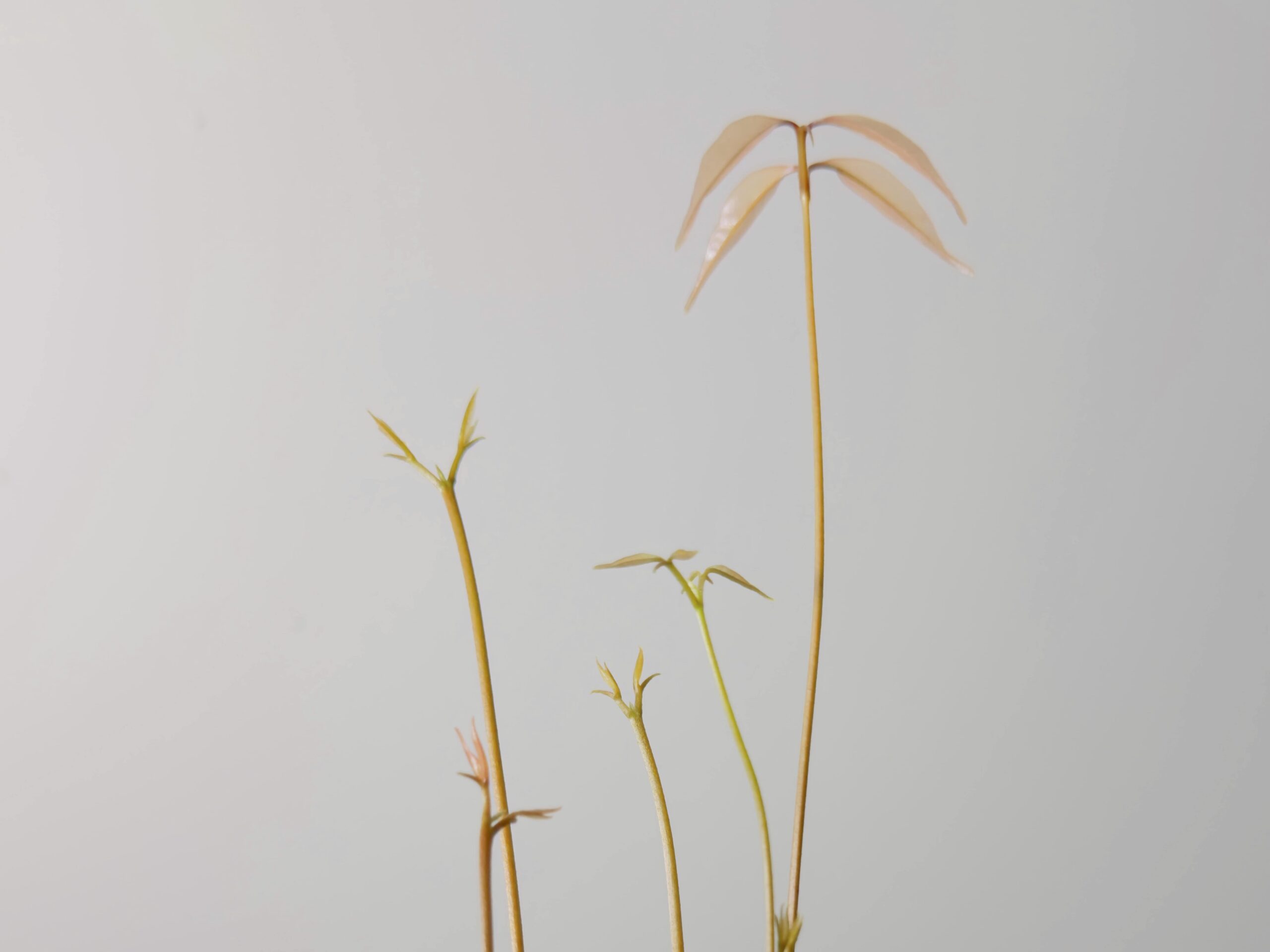
When the tiny sprouting stem reaches one inch tall, splitting in two directions, it looks like a little hand stretching out two fingers. After a few days, the little hand becomes a deer’s tiny antler. The next step is crucial: to grow pink leaves, cultivators need to place them in areas with limited sunlight. Under these low-light or near-darkness conditions, the normally green leaves develop light pink coloration instead. The limited light forces the plants into etiolation, where chlorophyll production decreases and other pigments like anthocyanins become more prominent, creating this deliberately non-green appearance. Cultivators document the growth process with photos and videos, celebrating each stage of growth as the sprouts emerge and unfurl their colorful leaves.
Like alchemists experimenting with their craft, the lychee enthusiasts talk about how to get varied coloration on the plant. Pink is not the only effect that results. There are a variety of pink shades, from light to mid-range pinkness, but not dark pink, as well as light yellow and white leaves. Eventually some people take the roots from water to soil in the sun, turning the leaves from pink to light green, and eventually dark green. Sometimes new leaves grow on top of green leaves, yielding an effect of multiple colors on the same plant: pink, yellow, and green. Cultivators share detailed techniques in RedNote posts and troubleshoot for each other in the comment sections. The precise timing of light exposure is crucial: too much sunlight and the leaves turn green; too little, and the leaves become weak and withered. During the initial sprouting phase, sunlight control is not necessary. However, cultivators warn against placing lychees in completely dark environments too early, because then the stems would stretch dramatically tall without producing any leaves at all, even the pink ones, resulting in spindly, leafless shoots.
Figure 2: my colored pencil drawing of lychee plants, 08/20/2025
The choice of lychee variety is also significant. A variety named feizixiao does not work. The name means “the smile of imperial concubine,” echoing a Tang Dynasty story of Emperor Xuanzong having lychees rushed across the whole empire from the deep south to the central capital to delight his beloved concubine. The problem with this variety is that the pits are too thin for the sprouts to come out. What cultivators desire are the big, round, strong pits, with plenty of nutrition and fecundity. While fruit lovers want to maximize the pulp and minimize the pits, cultivators want the opposite, which amuses the market vendors when they hear people want lychees’ disposable centers: “Do you sell lychees with big pits?” / “Rest assured. All lychees here have small pits.”
In contemporary times, “green” has become a synonym for “ecological.” In Chinese or English, we say “go green,” “green living,” “green energy,” and “green products.” The color itself embodies ecological virtue. Green implies a moral imperative of ethical living. This word choice reflects a photosynthesis-centered thinking about ecology, while understandable, inadvertently flattens ecological diversity.
Figure 3: photograph of sprouting lychees at my desk, 08/29/2025
By making green synonymous with ecological responsibility, we human beings may unintentionally obliterate the richness of deserts, ignore deep oceanic environments, depreciate underground fungal networks, and undervalue countless non-photosynthetic organisms and non-organisms on earth. Photosynthesis is central to our ecological thinking because it directly produces the oxygen that fills our atmosphere and enables human and animal respiration while removing carbon dioxide that would otherwise accumulate to toxic levels. Green is central not only because it is pleasing to the eye, not only because of its predominant coverage on the earth, but also because it creates a precise atmospheric composition upon which human civilization is contingent.
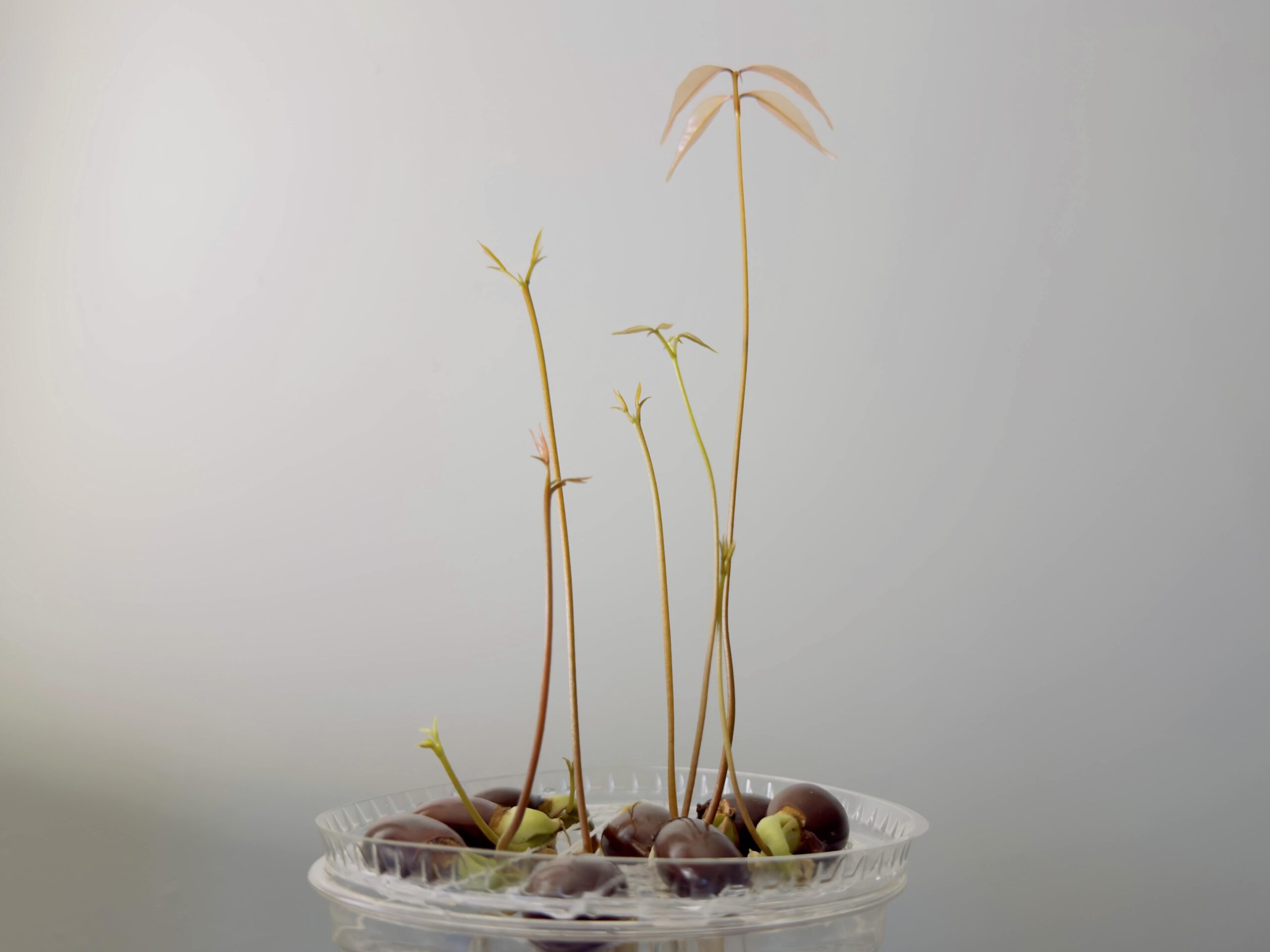
If a plant lover takes the leaves personally, they become sympathetic to them, eventually akin to them. If one reads it too symbolically, turning the leaves pink is almost cruel. Pink leaves may become weaker. They mark the deprivation of solar energy. Pink is the product of confinement. Our moral intuitions have been shaped by the photosynthesis-centered thinking that makes “green” synonymous with “ecological.” However, pink lychee leaves are more resilient than assumed. They thrive well in dim environments.
Figure 4: photograph of sprouting lychees at my desk, 08/30/2025
Our surprise at pink leaves’ resilience reveals how little we humans know about plant experience, a gap that extends to our ethical relationships with them. We humans don’t typically think of plants as kin. Plant ethics is different from animal ethics. With animals, the question of eating is central. Animals are believed to be more sensitive to suffering than plants. With plants, we cannot imagine not eating them. Contemporary science has shown that plants are sentient too, though in ways different from animals. Despite that, we humans do not mourn for them excessively. We love them while feeding on them and prune stems without moral qualms. Plant is even my coping mechanism. When a person has no reaction, I take them as a tree. I enjoy trees’ simple presence, have no expectation of reciprocity, and accept their indifference.
Going back to our theme: decentering green. These amateur lychee cultivators on RedNote are not consciously challenging green’s centrality. I have not seen them mention it. They are drawn to the spectacular beauty of pink leaves. Or maybe they are considering green’s centrality. At least I am. Pink is on the edge. After Barbie, pink is back. Pink is feminine; yet pink also stops being equivalent to femininity. Pink has become edgy. Pink challenges the photosynthetic thinking that dominates our ecological imagination.
About the Author: Siyu Xie is a PhD candidate in Comparative Thought and Literature at Johns Hopkins University. Her research interests intersect the poetics of botanical knowledge, literature, and eco-philosophy. Beyond academic inquiry, she engages in creative practices that cultivate ecological ways of thinking and sensing.